Quark Android Malware Family Analysis Reports
DroidKungFu Malware Family Analysis Report
New Quark rules (#00212 - #00233) are now available. These rules target DroidKungFu, a malware family that gains unlimited access to a device, installs and uninstalls Apps, and forwards confidential data. Check here for the rule details.
With these rules, Quark is now able to identify the DroidKungFu malware family as high-risk. In our experiment, Quark achieved 100% accuracy and 100% precision. Check here for the APKs we tested.
Below is a summary report of a DroidKungFu sample (D277C97B1A8A78F859672B4A20E74B3313E9F964E68A6E857C1E9D33763434A5). The report shows that Quark identified the sample as high-risk and provided a list of the sample’s behaviors.

Identified Well-Known Threats
With Quark’s rule classification feature, analysts can generate behavior maps and see how behaviors are related. This feature helps identify 3 well-known threats from DroidKungFu, as shown below.
1. Gain unlimited access to a device

The diagram shows that the Lcom/google/update/UpdateService;getPermission2 function runs shell scripts and Linux commands directly, and also calls the Lcom/google/update/Utils;oldrun function to execute additional commands.
Behaviors detected by Quark:
Run shell script (#00069)
Execute Linux commands (#00068, #00155)
2. Install/Uninstall additional apps

The diagram shows that the Lcom/waps/k;a function installs APKs from a file, and calls the Lcom/waps/l;a function to install more APKs and the Lcom/waps/k;b function to connect to a URL.
Behaviors detected by Quark:
Install other APKs from file (#00054)
Connect to a URL and set request method (#00096)
3. Forward confidential data

The diagram shows that the Lcom/madhouse/android/ads/_;_ function queries confidential data such as SMS and call logs and also calls the Lcom/madhouse/android/ads/_;__ function to check for network connectivity.
Behaviors detected by Quark:
Query confidential data (#00077, #00219, #00221)
Check for network connectivity (#00224, #00226)
List of Tested APKs
The table below lists the APKs we tested.
in dex |
sha256 |
|---|---|
1 |
27 A63D6412B3459E821D88A8EF133727B8DDA99262CEC71C9989EC28E394F173 |
2 |
C3 B0FF9C168FCDB02573AF741FC1E9B9E3EEA993A5407CFCF0BB29E0800760BE |
3 |
E1 0A9E9A5758F04975FFE930AF08A339B897FF72DF85BE1707184C697C0E954F |
4 |
2C 6B542B30C644BE1840E38EB8ED4592B671E4734C08FE57B315B92299B23A4A |
5 |
1E C91FF1EA8ACCBC4181F3DF94C6A285013EC7A7D60467DEB9250E7681F4B73C |
6 |
20 639CFB1369F3D490ED532FE30E294ED4058B7D67C426484D7028B7B2B165E5 |
7 |
5F 7A40015A1F3F42802424EC776799F5E0960F19E9BF8C86298AA5CFAC116BF6 |
8 |
E2 BC4E09BA57740C17F033F6B116EC0316771EF8C1DCB99145EEAC17F15FF2FA |
9 |
7F 027D19AD8FCD2F4C6A6C74742DED6D1D7758FCD72BDD8B5590053BE65A1D2D |
10 |
21 D4EB1ADA6CA0925AB8E21D30BFF8A40E88BC60773700B003C048BF8619E75E |
11 |
73 A27FCF9FDE6D7EBC39F4995BD7DAA4F433C37314C0016D75C50CC39AE7A785 |
12 |
4E A68DEB209A29ED0B1FA7F7555006DEC050D8F77CF5820B550E32E5A6F6F88C |
13 |
E6 440A1AB96884C44250F2DB53618FC6762DD13EEBC59D1095F1E188D40C68E4 |
14 |
C1 7D0979882468CCC26FDE81F5C6F0DDFB602F9AB9D3C92AC355C8D87A585380 |
15 |
47 7C68553FF88F831026E8842FE99FE14B2DDF08821A0CA3072B7EDBC872A292 |
16 |
B4 098AE6205E3808A6B79495B2027452A7B8191200402F8BA32DBA0EAB21EA99 |
17 |
39 3456E6368079F36DC0CEA861361F976A5CD6A3191B69E49CFD6BF4692DC57E |
18 |
16 A0C217F26C948D683B515CBB9E06CC0AAC422A951CE9E9E532D7A571152D2F |
19 |
D2 77C97B1A8A78F859672B4A20E74B3313E9F964E68A6E857C1E9D33763434A5 |
20 |
51 BFB82709E927D65770E5C59AB6EB96B73B19525E127F60A25831CD2B8AEE82 |
21 |
C0 8539123E1F40439E0DB7DDEEDD6BF6B079AB5E62B2208E22884B28306C1CCA |
22 |
15 D1FDC4B27509DF6D31F851675D03A21939A165B2011BFE0DB5EEA69BBB6B3D |
23 |
94 BC85F5458E313AA138C9F4E4B8ED3AB8642694A07427B80441B8A538EC462C |
24 |
41 DD548C530516448CB6A28DA67407725163F9620D92A35F8735FA4135ECC0A2 |
25 |
A8 7C8FE4D821CB2B15FB4E1ADDF63E88DE7D09D37178A910C9221EA979C16F81 |
26 |
3B 736A91DCA7AE8608C2174AD589400D3FD5FAE55A395920841A49EB10657A37 |
27 |
80 0A8CFF0C559C9478E6941B5E0B30E3848E8A0F9246C8E0C1A34A1459288D68 |
28 |
BE DF51A5732D94C173BCD8ED918333954F5A78307C2A2F064B97B43278330F54 |
29 |
E2 0D4994C8A13854CD835919F5620A9B6217AC444016F9E97C3E9C3464E2F5CB |
30 |
AB 0A824F00E4AEE68A17DAD86182B6FFE83D6D7D07D572D31183CF4A8C1723DA |
31 |
AE BB5050F17588F0D3936B1B13BF7DCD856A7ACD8DB107C4853E7A9058D2A0CA |
32 |
AF 33315DFBF3ED5A0D28E8ED03A79D20C3B77B16129CCA9439BB4CBDDCA076E2 |
33 |
0A E6CECB96E4515F4536EFC711D583A447FFFDF2BCD4E04D2F4A0347F63E40EA |
34 |
3C 81C9DF7CE0F94918CD0B833B070DFBBCEACF8688824AFBC6344E975EDFEB24 |
35 |
C5 C508FD88D058F5E2B3ABC2A066C52C1FAFB148F27000C47DA859945F771512 |
36 |
FE 98A9B6D1ACF4E2B52CAF0015E90B9FAB856B0C0AA581D526F3D2951B2F7904 |
37 |
BA 949E090EAB02005F9B1823B59AA4329017EA2441E81734F4827B3822C9704E |
38 |
B6 BF9FACFA89990ADF7F01D561875AC54D7577CA351D0C23D69B5E83E376963E |
39 |
2A 93EB58C737572DD375A36F8A5397140C815DCAE05DC80DAFAAD4B3981A91B6 |
40 |
D2 E2396D8F6052E551E84CC69A97DB7D3D08DF9B3AA40C0070A7CE96B33622C8 |
41 |
25 BE589140F73949124F08759AB5BB57B126396F1401E3BFBFDC5E5C056E0D03 |
42 |
41 BD9843692B7421B2FBCEAC3C2F6AF3CE9C92339C10D43898E7E072B8E28BE3 |
43 |
3A C65392A5E371D1FF5C7A2CBF580A4F3C2A5B36E11C01601D6B38D715C2A74B |
44 |
5D 3A915B34D0925B9EA4A7E33E8E70A428B22CE57CD17CFB20DF37F463502B82 |
45 |
94 A96E66ABC0ACEF751AF0C2140AE7CAD05E434609EB56FE6A6E6602FFE3E4B9 |
46 |
67 E794151DD32338E0B1935A77ACA5B9A8D87C12C7A088326C2E9F2FFF048279 |
47 |
40 BA6610360FFFE5BAFEE8504751C78B5AF3B913DA1C2D4AE97AEEA156E5510B |
48 |
19 7041741B0DD2FACE3C01A2FE82AC697A6B6B801B7DC2D3579DA7BBF56ACD73 |
49 |
8C 5130774E5F1E8F6A0A16281A5AF22C5AC1FCD46DE907667714760ECB76F7EC |
50 |
86 FDE6F59EF9A8F762AF7BB62DFC4467CA9BD3ACC63E50E5AB78A7B4487ED70D |
51 |
0B 33469936791DB785E8546BB752AA75DE4C3227293A4237249DBD05FC12D039 |
52 |
25 061C50965D05E98E409E3A07FE4CE4825A9DACFF46A79FE57EDA7BFD184DEA |
53 |
D2 187491BAD25E07B6817CDD3F044466B8FE2BE63D255DA2FE7CA58E8C8C6321 |
54 |
44 6A635890947E7956D5E8DD10C758A733144D573528153D6F5AFD0DD038BFC4 |
55 |
DB 104CAC9471650E5E5AF54E14C80F6247E16923E78E41DFAEED42F28CF5C523 |
56 |
42 69E9F03F43D82DF992B417E961554CAECB80D06CA3B0C1B847A09FD257901F |
57 |
C3 1BC398066441E6FDB5F98EE6A4529D6F51925F4951EA679C028E50D0CAD950 |
58 |
EC 6212709ED75DEFC848626D2888B685AEAFC4FFD655AD830557F9994E8995F3 |
59 |
66 BB9310F7063CC3B12F803D2C809C1DB46AB29F229599BE81728C432C208C9F |
60 |
BA A24D27A78F0641ACF806BD03722AA47F1DCBC42F1CCA04B14B0118E398F94A |
61 |
AC 5E59080E8E951AA5C62038D606E2BD3F8A20C0552F8E1B326B407D4BDCAA15 |
62 |
82 3EE1A0F81C0067F804B3F2497E8268A677C76D90DDD261A910CFE8D116897D |
63 |
F3 F52121296119FF32C334075EA80B74495FDE648A7204BED66268B285FBF199 |
64 |
0D 9CB8010681D5F35969FB84F96FFCC53DD0B37AEE62F522C2972BEBF2759F02 |
65 |
03 259A1228E3AD616F10C2370B8C142A8D20132505FBC5CDB5137322A8A03FC6 |
66 |
8C B684F1C8FDA8D16E9399F9B75AE1972888BA4398EEE1A7BAAB311DAEAD5F0E |
67 |
27 B02028221B1AE647BD749EF916AC4D0AD39BA3C961ECD1AE37DF7988488225 |
68 |
56 628C603FDB1F33FDB8E53D796919F5385A9BAC31E3217A20F2E7531543CBD2 |
69 |
00 621E015191863041E78726B863B7E1374B17FDA690367878D1272B0E44B232 |
70 |
4D 62CFEE89DFC4451BDA6FC9E6C09189B6BAD089E2E97E36084FD0E910363D76 |
71 |
04 9D5D5E6DDA98F512E0A9FD2D8E3299BB16ADFB63D95033ED6A839588D14425 |
72 |
64 AB7A8E612D8D60C1C4CC8CE1B4ACE4AAFCEC7E1F5239894F2B214B094FA1B1 |
73 |
3E 38E7FF5776548DA0FA1AFF91B364B338D5D7D51E6CB4E3ABFE2FF4B9BF985A |
74 |
3E BB4C2BC959080EB9BA2328D10610B59E77892667F8CC5794479F0625E283EC |
75 |
4D C7570244C38A690BCA52A8DA1B9108C7A0EE214FBC0A972725D43C8C78FA9A |
76 |
EB 2F047FE3AEA452F1867EC57FAE2E4E853652FE9CBABDD995A11C6FEC0D6500 |
77 |
1B 7F0C198CB2278218B177F79F16D8C8CE9D7E46E2E65D2B6ACD61A3BA8C455A |
78 |
8E 6DFA5676DAD428FD3BB767D33B74920D4B3E5D51821A1501D0ADC35B834A50 |
79 |
24 CCB1BF995EEE442CC4BB86828795BEB0043CA5BF694B3765FBBDA7F69F4E40 |
80 |
E7 0FB0052314184463A9F7D194DEE438FA381C6584B8009F178785E0E8CC5D66 |
81 |
BA F7340F3F1FD943A0A0E79FF59CAD5362D1BA45F05EB172A6730455F8CD55FA |
82 |
CD 3AF68A6C2D93D0261962F50F8DBBB9D72BF952A88414B33DDA49C613DBD8B5 |
83 |
BA 14BC0202CF321F4368E0DEE08E67CC7B55AC3A03AAF1726E03C4CC0AB44F02 |
84 |
05 C68734C04460DFF87618C0065457788EDCAD84C23F32113B156A963290D917 |
85 |
09 B952BB0E499EA71E042F6984E6E7632FE1B2F646E212E16468B54A7D0E4253 |
86 |
70 3B9C40116A1AF70522933D25B72E85863EF177F937B28CE82C048928C83379 |
87 |
97 CE153A87917E46907CE3C43328FA398BADA713ADF9DF7A756174EE8C7F50E5 |
88 |
A5 706AD49019EF9671242437834A492170F6DDBBD11DF2BE8D0C7F0477530CBE |
89 |
4F FF4F4F98197ACD4A943ACEDE362D4C64F9D20EE5E64F7D0F4E66F3DD08FBBC |
90 |
54 F84DBB2A95A53AF72E7346CBE139BDEA1759C92C50AD202B66E8F6D548D876 |
91 |
93 BC7CAE3DC7ECAFB01A9D136A7D24E280673F7DDE1B30F545E1FE2646E8A66C |
92 |
66 ACC04320B125B0974DF859850C1A5B2B9C2B58768CBAB83A93BA955FA9287F |
93 |
C5 EA7E9101DCE70C56A0F48B622FCFF619D615F5034B15D21BDB7F40B74602CF |
94 |
14 F44E244274BF9A698960DAA82D98D3FD66AC7E8FE6F7F9916F164E468C30A7 |
95 |
0F 2931043C240C14DE48C7A6630752474C3FE5A87A5113F13851CFE8D14754DC |
96 |
1C 5A89EB4638229DD8DC6D4F55BCAC8D565D2FEF20F6BEFE52270D50973B6151 |
97 |
A1 F98073B0D39B6E3A981D7DB2C528CC9B88A4CC207350F4467916F265D0244F |
98 |
A1 28DE003C61B08C439F181253A5C8882DE1C48F517B0B0BF6B18614D11E2674 |
99 |
D6 95B7310BED20E3AE00C0C4754039C3BB095062F4D746897BDF417444F454C9 |
100 |
F5 2BD07D3457B69720C9A54BE5730545BFCC80269BE749FACA723906A303AD33 |
101 |
B4 524506739CBF40D3C823D716FA2DEB9ACE38C199CF0F7661FE8DDF688953E6 |
102 |
43 567A80FB8122F77E1CF72CFD898A6B9BFDC18F27EBE716C444143E03630200 |
103 |
22 20A2EBB3068D1C912189CA6F8E89D0E63836E40A75F5E5C2B7B99A498E7CBA |
104 |
E5 8BF56343D6A44B0D863534426109B348673C76EC433BF310E638F34EB786B7 |
105 |
30 866091584856AC8A7F353172C3D9B0643602F351BE56BA92B4AB2DFD68230D |
106 |
1E 1D93EDC231E7F2FAE9ABB825640E803137A1A672B9D5E93BDFA6D7E8F57DCE |
107 |
3D 210599B3EE6C84D9D8FCB236C02394D24974EE3E0FE2D03B013D538E611CE1 |
108 |
51 07DEDE507180C8458C4E5F87E27F580521F365A54D9E71286ACF0E54DB9E1E |
109 |
5D 5624B266E294C0DC7673D2FB8E126EC559D37CEC74C5508D8E6674377EF107 |
110 |
DA 2EE0B84AC470986543ACCA1F4C51DEF534D23F04E39F0DD85CCCBA45232738 |
111 |
72 865ADB5BAFDA646F6F60834E0462E1626C88F075E4161F3CE0EBF217D6C4CB |
112 |
8E A992D99898B26E014F82C475F605D90BF0828CFE244922197020B62147B55C |
113 |
45 36BF0914B3D76047AEB6EA92F21D0CB7561F68DAE870DB3F6DE9FD7420B785 |
114 |
CA 8EB1155C2F5B33822B906F2255CDEAC0EEAD86A58F151C11BD5003458CFCA1 |
115 |
00 1E0F67B5BB9DDAB14FACBEF94791EAED0EB939BCB651D19DAFD0E2A05D8178 |
116 |
37 C1F16781B2399019AAF2525834ADFE00592F1C62D07D1B0C91A40E11D1B80C |
117 |
F1 57946D3868FBE013EC23B14F1097BB727654B4F3926322F035E86E3F5F637E |
118 |
E9 484114F77952ECE8234927BCC865886938C41F4F4657741F01B22A214E10FA |
119 |
B0 CCDE6A945212ED23F3E85CD861D73A42A98C53D63237CD3C0EB67DDA57BDBC |
120 |
C9 07757169BBE2A5FA05080B75E5E273F0EF02B06552BF4DF3C386096FEFDD20 |
121 |
0F A18A95361BBF4413A9B734B540F52C6BD2411090DEC4D7E3DB6708FEDC68AE |
122 |
6E D52331A788EF18727C8E34746B59DB81ACDB261659934BE63B0266FB7C19E7 |
123 |
BC E128DBE9A75CCADE50ECAD2E52499F67E58479ECD69861B3D117984DF47136 |
124 |
AB 4B4D65A4C7CB3AAFBB7E6630830393D43E619881DA76EE06760466FB79E894 |
125 |
87 7BBED1EC7BA716D70754F6F015C950217FA16F6EA70833B0196C7C560B8239 |
126 |
00 15AE7C27688D45F79170DCEA16131CE557912A1A0C5F3B6B0465EE0774A452 |
127 |
B2 4B268C7C9574BB5FFA48C239F77089BD14BA3EA8B6DDE3DA42958569477D01 |
128 |
38 070B4D027E0256E6B8538384E374E14D7F8006920A60E9BB9238CD45855CC6 |
129 |
7B 5338E1E7BF8B4816B821DB9ED042ED13CE4F8EBD1748BA9788B070E45BF03D |
130 |
4F 1CBB091DCDE0CD0E8FE0D4BD27134750BAC6711029E0A37179832AD3698EA9 |
131 |
E2 6656A75FB347F317ACC7A670F8D16DD4C4433691443A77B46C84B9E3A0FB66 |
132 |
B9 0564F3809FC8B0B0CE1CBC53DBFF6C6A293BCFCC5EF7821E28BF87262FB9FD |
133 |
EE 21782BF346B26411CB00CA83F91AA18C01CF67086D500E66672A0DE046FFAD |
134 |
24 2A0048497BCBDEB4D1A5A43DF08E492BFD42B0B85FF63B2C2A49AD5EA50829 |
135 |
53 702B51E102AC3AD7C859019B8640B88D65B3D6008825ACA2D1FCB80B2FA845 |
136 |
FA E5B82A8DDD7C6EA2B417711E7D0FF8EE02244B7FF9980BCDADFB940EC85096 |
137 |
0F CE8643A036D954E75ECA205B2EBA45629C999AA13ABF8896B4BBC07B0BCFA7 |
138 |
D3 4E040FD052963C9348B8AF50B415419216BE1A00DBF25C7F7B86545EF84C7C |
139 |
9C 6724919CAF4DC134AACF828A62663084DDCD6459FD1249DF36BCFFC7EF2EBB |
140 |
91 84D161D1931A58CFA091569CDE481FCC87AA3A4D32C24622A29EAEA5FC3EEE |
141 |
C9 2E7ABD460FF39CB41709416959366739B08006DC2EEA05E367981F9578E6B0 |
142 |
B3 27C0BBB16C9ADCD566877AC29DC0B0EDCFF9E654DAD66C514B19877A45B6C8 |
143 |
62 923018BFCFB2AD1F05EDE135024EDBBADB20DFF9F816EC3F846B2900636ACF |
144 |
2B AF6E70672789096752383F0DFDA9774A3FEF55CD64C5AD7FE5CE02F4BEB8FB |
145 |
72 E6AE9CD081F8D38488CF4077F66DB0F97CEF486A60EB38C593BA82DB77ECD8 |
146 |
F6 EB0EB6FDBB4A1615050F59EB6FAE8F999824E5D65CE1A437761FE7BE4B8215 |
147 |
F7 B038B441E051B3BCC6F40964C215F61A3A226EF3A1B8D58A36E135115DBCFE |
148 |
73 5F5724975302D23C7CCB6F69C0AB4C64F3E63AF38E828E302DCE79FB08593A |
149 |
80 612FE193401626268553C54A865E67B76311E782005EDE2BA7A87A5D637420 |
150 |
93 8EFB5BDC96D353B28AF57DA2021B6A3C5A64452067059BF50D7FB7C7A66426 |
151 |
84 C7A452E72ABC4EAA51AD8F3569A6E10365804A963FA61C034FD1F3DC846957 |
152 |
07 FEAA0E04E56CB3CCD06FD7902A9D9CEC48DFD901BD6D5E07ADE81448DCC5D6 |
153 |
64 47ED2ABE5AB3827C519BC1EB732159FFE284BE73B8780F294F562996DC9C47 |
154 |
51 37EDD9FA6E73BE3B5C14C50FAF0B6602C7A155E30A931D2A98B31AC1E021C9 |
155 |
53 B1523A8F52D3C924043B93AC44FB96F2D496D1C054D873E62B5BC9644B1B52 |
156 |
D7 D47ABC80CDBC7D0AEDF9B8E863E28F0B79CA47D71155A3D364EF096DF98D7E |
157 |
AC 48E0526730A611D363AE5DBFD2F3AA4296BD71C66E13B9DB3D272B754EDCD9 |
158 |
42 2B2A9F8547E4239E1BB508359872C6365B42ECC460C82A0FABAC04F2E44808 |
159 |
7D 4FD317B9E19AF2BBC5B707C3CCCA5D504B11371D10E3CBAF0AB4E56D0ACAB0 |
160 |
D5 C60074995C0AA0842AEF02269C8567F8B59902E4AADB865C69CB3738D9051F |
161 |
C8 B6CC0BA9DDD2206FD35AA3AD379B169DEBFE223A0EE0E5AA28DA1AA683343C |
162 |
92 1F76D6153E86E480A1FE309A19DA4F75B85BC3F85F3826694977CD2046F0A3 |
163 |
C7 C46F7E5F58B1E6912BC0638475840741CAED5685AF0AB6B563A637B92D41A3 |
164 |
37 D382FAAFCAAD6F8BF5DA383CB8703B7094A045AEAC5E13B5F4225C6272A615 |
165 |
65 CEFD92274FB4AF9F33728F8759A6BE835C7550B96EDAB798787CBB8EC95FB3 |
166 |
28 7E705784FE12335E9355C20F8BC8072A7A6A87DEA751CE471CCE37D426E9F0 |
167 |
AE F39A6FAEB83695C7D97B93E6BC550D0AED93EFE886E651A1610DD8B2ED013A |
168 |
CB D9BA3E8D82F9D475C81BC3C057C19869810B2CD47E6EDBF392B4A7612F8239 |
169 |
51 F16E4D41EC420E8520220D44B0088C81619014896BE524F411B718E730A33F |
170 |
CF 997FE5C0AB00EA447EE13F7DEEC8E97EFE412F65355448F04565A1F7AC0E72 |
171 |
E4 EB02B2D64D33E4C0536406BFC9A6D8FCC6B5237642D92333EE3E089BD82723 |
172 |
5B 8D52ABE9FA8E849A89CF87F90CB07E77BB429E0FE5F518873C8B26EE231A87 |
173 |
C9 6029C4F9777C9D521249EE1AC27F75C2350614C361469D0C7B3F8124DA3E14 |
174 |
A0 E3891E0790A9EC38EA05BCC0EA7067E98CED68DBCAFEE10A5F73D560A97B17 |
175 |
FD ED1EC2D17F957B230FEB5FFF518EC98322A1617E4E28953FF38270CB16098A |
176 |
EB E06DFB790CCEC41432637C593139E6C813AF0BA0F1366FF9FF12F8DD89AD40 |
177 |
2D 2C183A82B5F13E458946DEFA3D2DC361B6FBB1321FE0535DAB40FCA4B7C272 |
178 |
A6 291A63E3B4E8E3B58E96DB2A98BA918E674B21B3483EC0A69DA5C5594390D8 |
179 |
C7 BE73CAC9A130F487490E98B811F707492F92EEB989D75681F113FC7B184F95 |
180 |
35 CEFBC2F7DB302E881DAEBB572093D721E3E94CDDEC465B6F08877095B572BD |
181 |
6E 417844E162251228B6305C70ACC481F423036C6F14DA753F8C591F115EA8E0 |
182 |
58 96A3D47B5CEEAAD8C69D9811C79438233EF78E042EBEEFF807C69B6EE63FB2 |
183 |
3A 867B8D991A3125CA3ED27E2F0D6568277AEC1CD15A0D8F9201981F4A5EEC6D |
184 |
D0 F06064FD7C105AFB139A30010104E1FE4A41A0967E450F9509ED7AA793AA1A |
185 |
F1 9B3B007B54813C8395F826D76ABB6C7573286D9866ECF1F71CBBB75C12BF04 |
186 |
EF 2B268D4FF17708D1D01E363CB486E7AA83616AB595434535CFB33BE0F716C4 |
187 |
E1 16D6C8F922AE101D2AF721AF3D183DD12D47A167312266E54C02F8B5AE53E3 |
188 |
C7 EE00F75D464EFE63FBF3998517B171AA296DBD3254E95DF25BC579F8517AA2 |
189 |
4D 920F5202A33EBD9BBAFD73E11D5D222D4B8E0D50C11BC9B8B5F4E291F7C8E1 |
190 |
02 E112947AA19A577FD9D825531BD74797BBF5825A74E9918D4027BBD24BB49B |
191 |
9A C9E6123537F163E7730768B1B39BDA34A7831B5A3F8752D2A0CA4C394F5752 |
192 |
2D 1EEE053F84BFFF1C9F4F82CAD96DD60D04596236DF9B929A921E32BF4EFB0A |
193 |
31 4BA33232F07D0EAE2648A6DF5B3009484CFDBDA6E57D8A0B221D215EC5300F |
GoldDream Malware Family Analysis Report
New Quark rules (#00234 - #00237) are now available. These rules target GoldDream, a malware family that monitors SMS messages and phone calls and uploads them to remote servers. Check here for the rule details.
With these rules, Quark is now able to identify the GoldDream malware family as high-risk. In our experiment, Quark achieved 100% accuracy and 100% precision. Please check here for the APKs we tested.
Below is a summary report of a GoldDream sample (ECA3A3666B0FD72028431431E7FAE6774A8CA692E35AE3CB44FD8F2AA418F746). The report shows that Quark identified the sample as high-risk, with a list of behaviors as evidence.

Identified Well-Known Threats
With Quark’s rule classification feature, analysts can generate behavior maps and see how behaviors are related. This feature helps identify 2 well-known threats from GoldDream, as shown below.
1. Monitor SMS messages and phone calls

The behavior map shows that the Lcom/sjhi/client/zjReceiver;onReceive function monitors SMS messages and phone call activity. It also calls the Lcom/sjhi/client/zjReceiver;a function to collect the data into files.
Behaviors detected by Quark:
Monitor incoming call status (#00064)
Monitor incoming SMS message (#00234)
Monitor outgoing phone call (#00235)
Write data to file (#00236)
2. Upload SMS messages and phone calls to remote servers

The behavior map shows that the Lcom/sjhi/client/e;a function connects to a URL and writes a file to an output stream. If the output stream is from the URL, this indicates the function uploads a file to a remote server.
Behaviors detected by Quark:
Connect to a URL and set request method (#00096)
Write file content to an output stream (#00237)
List of Tested APKs
The table below lists the APKs we tested.
index |
sha256 |
|---|---|
1 |
DAAFD978B9C3D6CE45DF705F9C5DE432609546673441A7F1ECAE7C4F42069FE1 |
2 |
D710998CC0C38046D8C3713463B992B925A647780D61030462DBEE41094D2E21 |
3 |
C2236E4159E14623214C9F22EB8B373AE47C20CEF126398B7EC2D11DDF7133CB |
4 |
30838B9223D7C9A029D25903030C0EE5784E2556F3FB4994A9A66D0E52452915 |
5 |
F44FF1D306731B7EA378569545963A71254145252C2D26CA6F679CAA8FD39468 |
6 |
26C12F1A899DBA752B29B20B599CEAC2A814BE1AB3CD50BEB96A26B6033F2F1E |
7 |
38A90E9AB4FAA62EA71F1FC726BA4B747FA363D9F4D15E7478239E771FC36BC9 |
8 |
72A3B68C5EBD84E1F9FF9AF529A2102A1DE08E7F1CA5B874CF1FFB4B380AF7C9 |
9 |
594EBCC14A163B86222BD09ADFE95498DA81CEAEB772B706339D0A24858B1267 |
10 |
4DB9936E2BD190CC35710264179D5FEB28735C0661991593F28D5FEA6B2A3998 |
11 |
021B664D927EE81E90B936E6B880844B040753BC048DEBFF0358B39FA15C39E7 |
12 |
6F3FF062C0A4CA13A12C68FB3FC17A12F75BD18BA6CB76CC82660F026A966990 |
13 |
ECA3A3666B0FD72028431431E7FAE6774A8CA692E35AE3CB44FD8F2AA418F746 |
14 |
05A64C76B56919F4C6063CE376B59AC84C707425D6A442936B5AD659F7293C1E |
15 |
36D7471FA1E7C3AF4BE233F4F4971B41CF0A1EF1067D4C3B1D3BD4C3CD3D2E38 |
16 |
70F447054FD798F6EC3D6E67104F0910C73BAD80A94FD83AAC4F119786A0F253 |
17 |
545E1A911DA1071D79D9C40E945480FD9D5BA051472991819F8EB2644C5A6F3D |
18 |
3E72CC3C0DB3513A29FF53E27726FB9277C7D2F13661CF0DFCA8EB34DC690074 |
19 |
FF2BEF8912CCD5CEE93DC8C6FB4BE2B142E790A30689AFEDB32ECB665AD1F040 |
20 |
BA84EB2885F01C15DFDA3FE394486BE9E7E0FAECE28EABA70B007BE5864C233D |
21 |
42979D0E32550419DFA7F7BB1C5CCA245056E0EC50B489CA73C259E45C76C66D |
22 |
969BCDB8DC4043483AB645AFFF4616A1845F2276EF4165475F6357D71508047C |
SpyNote Malware Family Analysis Report
New Quark rules (#238 - #242) are now available. These rules target SpyNote, a malware family that takes screenshots, simulates user gestures, logs user input, and communicates with C2 servers. Check here for the rule details.
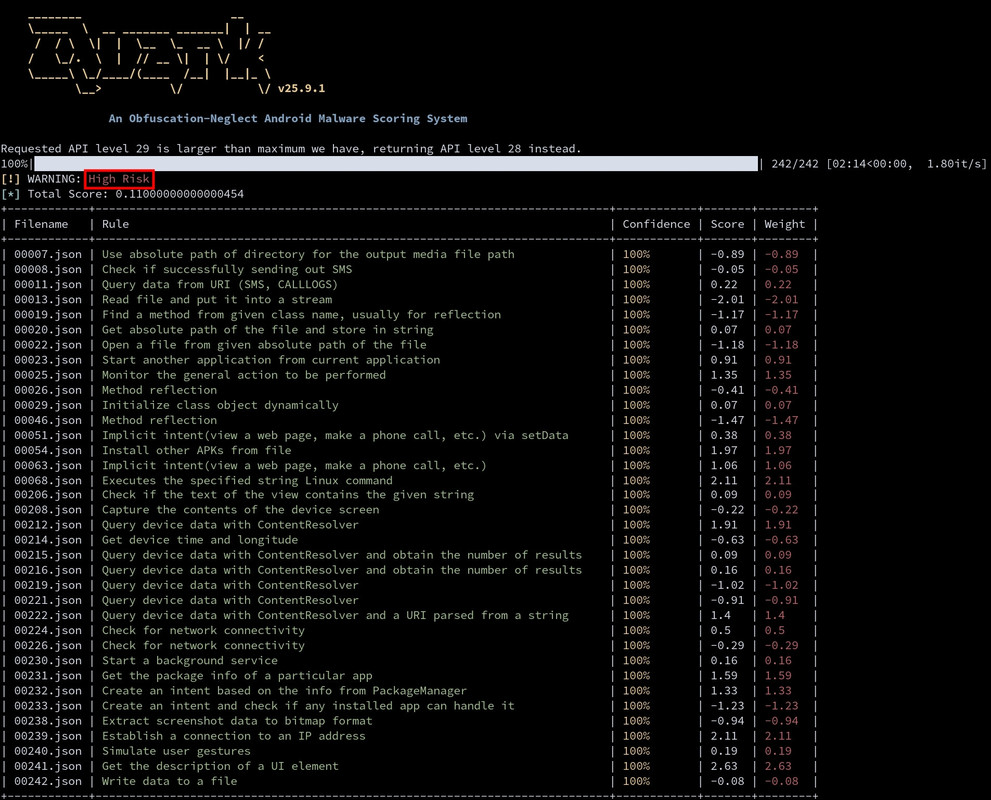
With these rules, Quark is now able to identify the SpyNote malware family as high-risk. In our experiment, Quark achieved 100% accuracy and 100% precision. Please check here for the APKs we tested.
Below is a summary report of a SpyNote sample (0713a683567125ea6fdff233cfa850b36a0d2c7d7c964510405cbdf669fe2a8b). The report shows that Quark identified the sample as high-risk, with a list of behaviors as evidence.
Identified Well-Known Threats
With Quark’s rule classification feature, analysts can generate behavior maps and see how behaviors are related. This feature helps identify 4 well-known threats from SpyNote, as shown below.
1. Take screenshots
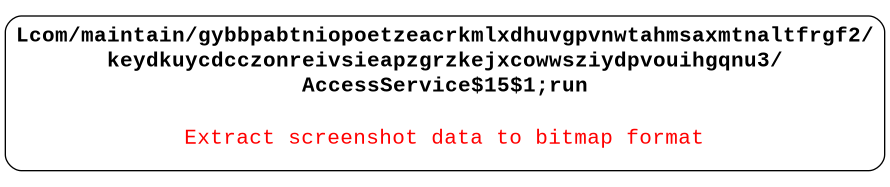
The behavior map shows that the Lcom/maintain/gybbpabtniopoetzeacrkmlxdhuvgpvnwtahmsaxmtnaltfrgf2/keydkuycdcczonreivsieapzgrzkejxcowwsziydpvouihgqnu3/AccessService function obtains screenshot data and converts it into bitmap format.
Behaviors detected by Quark:
Extract screenshot data to bitmap format (#00238)
2. Simulate user gestures

The behavior map shows that the Lcom/maintain/gybbpabtniopoetzeacrkmlxdhuvgpvnwtahmsaxmtnaltfrgf2/Perfct;clickByGesture function simulates user finger gestures on a mobile phone.
Behaviors detected by Quark:
Simulate user gestures (#00240)
3. Log user input

The behavior map shows that the Lcom/maintain/gybbpabtniopoetzeacrkmlxdhuvgpvnwtahmsaxmtnaltfrgf2/keydkuycdcczonreivsieapzgrzkejxcowwsziydpvouihgqnu3/AccessService;checkPassword function obtains the description of a UI element. It also calls the Lcom/maintain/gybbpabtniopoetzeacrkmlxdhuvgpvnwtahmsaxmtnaltfrgf2/FileUtils;writeText to log the data to a file. If the UI element is a keypad button on the lock screen, the user’s password can be logged.
Behaviors detected by Quark:
Get the description of a UI element (#00241)
Write data to a file (#00242)
4. Communicate with C2 servers
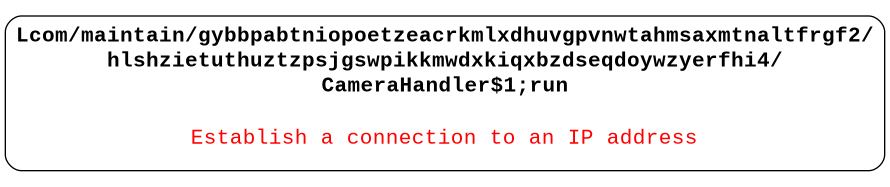
The behavior map shows that the Lcom/maintain/gybbpabtniopoetzeacrkmlxdhuvgpvnwtahmsaxmtnaltfrgf2/hlshzietuthuztzpsjgswpikkmwdxkiqxbzdseqdoywzyerfhi4/CameraHandler$1;run function establishes a connection to an IP address, which could be a malicious C2 server.
Behaviors detected by Quark:
Establish a connection to an IP address (#00239)
List of Tested APKs
The table below lists the APKs we tested.
index |
sha256 |
|---|---|
1 |
059b5f74e053c2966775157cd521580fcfaa3b1a7613560b8f499dbd9c11d4b4 |
2 |
0713a683567125ea6fdff233cfa850b36a0d2c7d7c964510405cbdf669fe2a8b |
3 |
4b2b411e03aafaa19ea93286fadd39a5134f4a039db2d5019b1054547c0d5601 |
4 |
5c01f7727c78dea9c89dccf92b01b4c45e69406e6462340779401497bf4d4589 |
5 |
8c365bd58edeb2ca371ead5e28350ee6c480a79f558d967ecbef525e9f1d7b3e |
6 |
da4f59bdc91eaeaba238a8ba9602f7d5cc75f0892a92f5422e23b55accbbb2f0 |
7 |
dd7650a9cd3f853e109d2d0138ede785e1559d6c2d8c52eec2f2d9808a924f1c |
8 |
dee1eaaa8879a7d321ef4e698203be7b23eeda80a6dea3c70cbf3138597b1800 |
9 |
f46b863952599b91a4d2d682a80f345dfa03fad473d1938f2c53a3139c87a019 |
10 |
eec5096dfca6824317863f9225c29f6c4b3442c48fefa62dc382e3569bca5a60 |
DawDropper Malware Family Analysis Report
New Quark rules (#243 - #245) are now available. These rules target DawDropper, a malware family that downloads and installs additional APKs. Check here for the rule details.
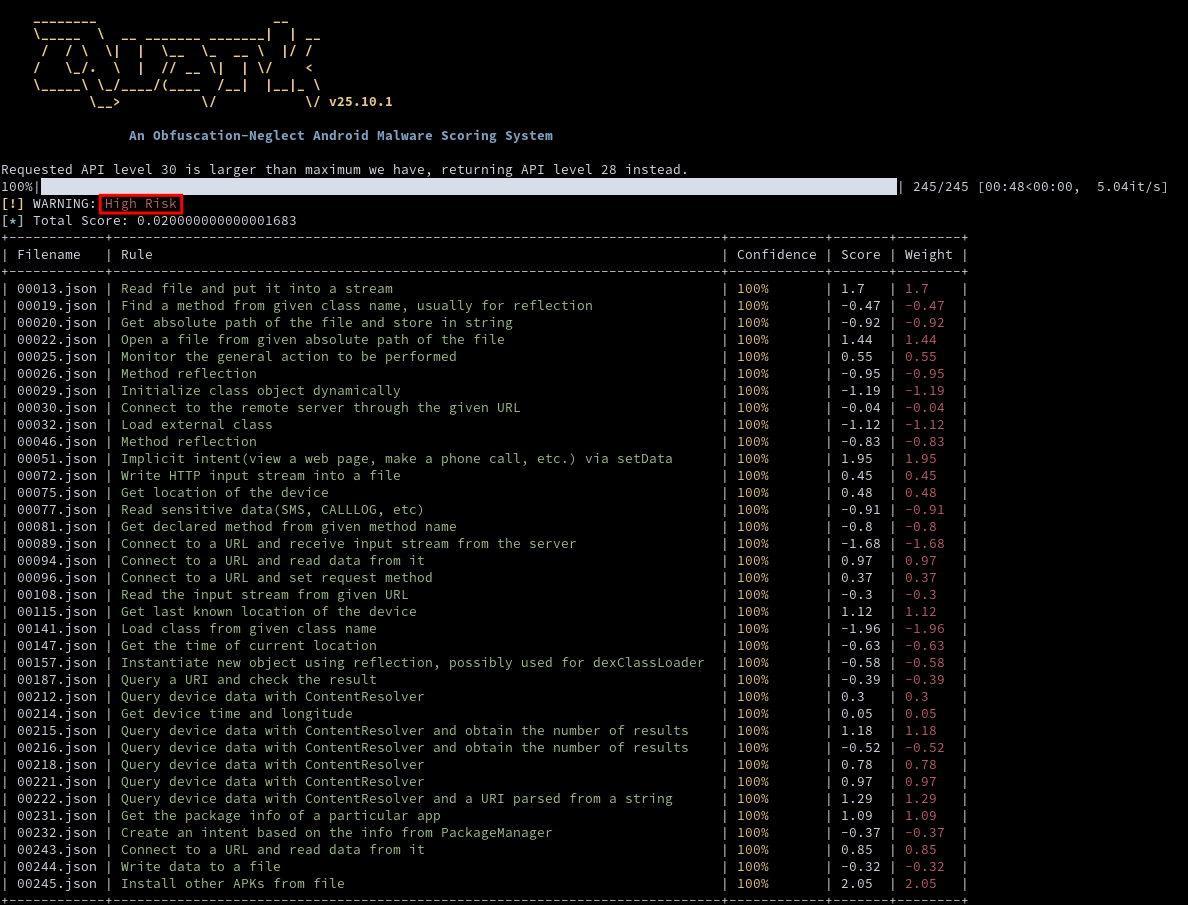
With these rules, Quark is now able to identify the DawDropper malware family as high-risk. In our experiment, Quark achieved 100% accuracy and 100% precision. Please check here for the APKs we tested.
Below is a summary report of a DawDropper sample (a1298cc00605c79679f72b22d5c9c8e5c8557218458d6a6bd152b2c2514810eb). The report shows that Quark identified the sample as high-risk, with a list of behaviors as evidence.
Identified Well-Known Threats
With Quark’s rule classification feature, analysts can generate behavior maps and see how behaviors are related. This feature helps identify two well-known threats from DawDropper, as shown below.
1. Download APKs from remote servers
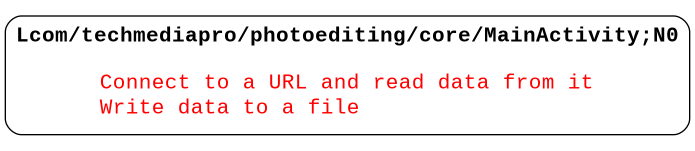
The behavior map shows that the Lcom/techmediapro/photoediting/core/MainActivity;N0 function downloads a file from a URL. If the URL points to an APK, it indicates that the function downloads an additional APK from a remote server.
Behaviors detected by Quark:
Connect to a URL and read data from it (#00243)
Write data to a file (#00244)
2. Install additional APKs

The behavior map shows that the Lcom/techmediapro/photoediting/core/MainActivity;S0 function installs additional APKs.
Behaviors detected by Quark:
Install other APKs from file (#00245)
List of Tested APKs
The table below lists the APKs we tested.
index |
sha256 |
|---|---|
1 |
022a01566d6033f6d90ab182c4e69f80a3851565aaaa386c8fa1a9435cb55c91 |
2 |
02499a198a8be5e203b7929287115cc84d286fc6afdb1bc84f902e433a7961e4 |
3 |
05b3e4071f62763b3925fca9db383aeaad6183c690eecbbf532b080dfa6a5a08 |
4 |
71c44a78cd77a8f5767096f268c3193108ac06ff3779c65e78bc879d3b0ff11d |
5 |
77f226769eb1a886606823d5b7832d92f678f0c2e1133f3bbee939b256c398aa |
6 |
8fef8831cbc864ffe16e281b0e4af8e3999518c15677866ac80ffb9495959637 |
7 |
9b2064f8808d3aaa2d3dc9f5c7ee0775b29e29df3a958466a8953f148b702461 |
8 |
a1298cc00605c79679f72b22d5c9c8e5c8557218458d6a6bd152b2c2514810eb |
9 |
b4bd13770c3514596dd36854850a9507e5734374083a0e4299c697b6c9b9ec58 |
10 |
d5ac8e081298e3b14b41f2134dae68535bcf740841e75f91754d3d0c0814ed42 |
SLocker Malware Family Analysis Report
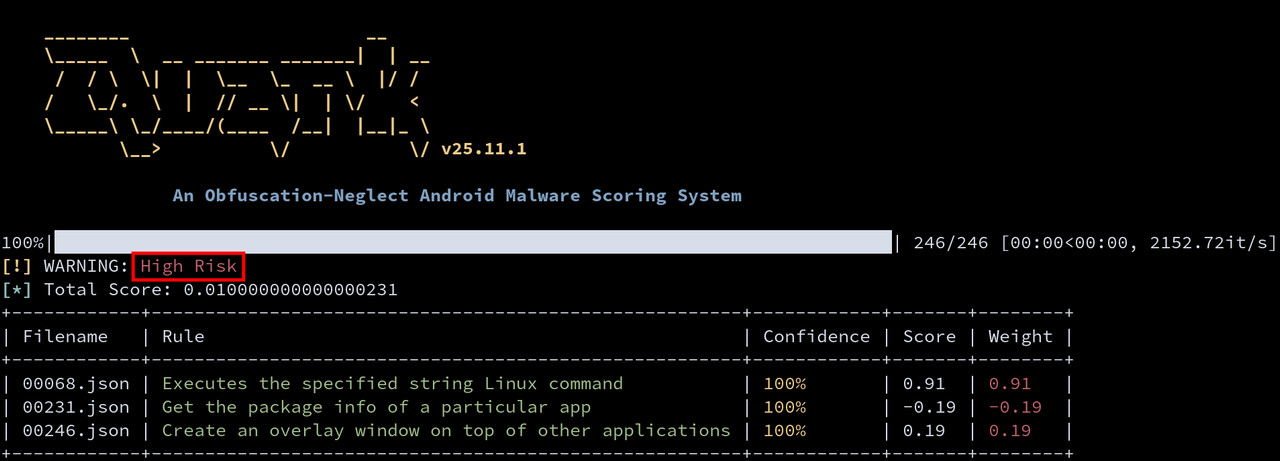
New Quark rule (#246) is now available. This rule targets SLocker, a malware family that locks the device with an overlay screen. Check here for the rule details.
With this rule, Quark is now able to identify the SLocker malware family as high-risk. In our experiment, Quark achieved 100% accuracy and 100% precision. Please check here for the APKs we tested.
Below is a summary report of a SLocker sample (570e2811e8c87f714eb3485c271ec03b9de699c6b7f67e858a24396ce5f7b69e). The report shows that Quark identified the sample as high-risk, with a list of behaviors as evidence.
Identified Well-Known Threats
With Quark’s rule classification feature, analysts can generate behavior maps and see how behaviors are related. This feature helps identify 1 well-known threat from SLocker, as shown below.
1. Lock the device with an overlay screen

The behavior map reveals that the Lcom/lololo/LockService;onCreate function creates an overlay window on top of other applications. By configuring the window to occupy the entire screen, the APK can block all user interactions and lock the device.
The behavior detected by Quark:
Create an overlay window on top of other applications (#00246)
List of Tested APKs
The table below lists the APKs we tested.
index |
sha256 |
|---|---|
1 |
35c39da84abfc8d8b89389524d6e203d91e5af8004720c60f13b492e14ddde56 |
2 |
570e2811e8c87f714eb3485c271ec03b9de699c6b7f67e858a24396ce5f7b69e |
3 |
88b86662dd1653845985544299fd8cc732f49c72d63c86ea3ffb7bb3b3249138 |
4 |
8ec195cd1f5c9f66c75000f26120832d7e1a9044fe3699d18d676bd5739b8518 |
5 |
9cc9fba099c35d65638f521e5a1d748ea432b64d82fe9732cfc52f8b57d3dffd |
6 |
9e875f82515cc6b27367ae20ef52b9e0d7476bf8bda91e2ba0d888cf0857311f |
7 |
a60082e481d6873103537e136b7b14a7892cd1205593d64567a448453eff4a6a |
8 |
b5ab87692109c072cc277246e957ab32cfce6973f9f06c609ba51b53114cce51 |
9 |
df091031ed5073de09158b3afcf1fb956d1f337a66e552e9d3458ed5f5f6edb1 |
10 |
e504ff4501da2412758babadabb05a761ae6edacd043d68334e384d94fe4f4ac |
11 |
f3fcd84b4e92a52ae5b30df003b911f21b2ea4325f788d5a5decc08582d3fd40 |
PhantomCard Malware Family Analysis Report
New Quark rules (#247 - #251) are now available. These rules target PhantomCard, a malware family that communicates with C2 servers, reads the payment data of NFC cards, and captures PINs of NFC cards through deceptive screens. Check here for the rule details.
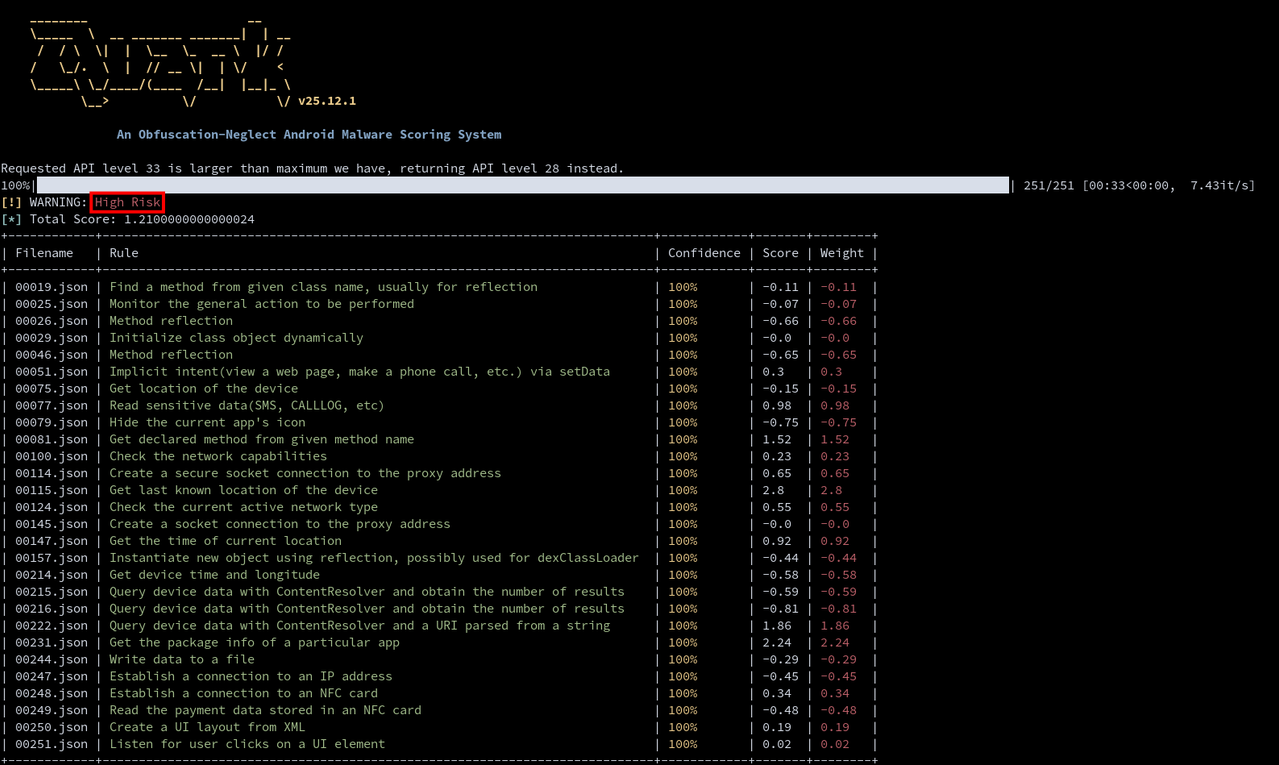
With these rules, Quark is now able to identify the PhantomCard malware family as high-risk. In our experiment, Quark achieved 100% accuracy and 100% precision. Please check here for the APKs we tested.
Below is a summary report of a PhantomCard sample (5769ae3cc93943dda4d1743f2febf6cec1282a0a6289da68cb55bb4724ec9332). The report shows that Quark identified the sample as high-risk, with a list of behaviors as evidence.
Identified Well-Known Threats
With Quark’s rule classification feature, analysts can generate behavior maps and see how behaviors are related. This feature helps identify 3 well-known threats from PhantomCard, as shown below.
1. Communicate with C2 servers
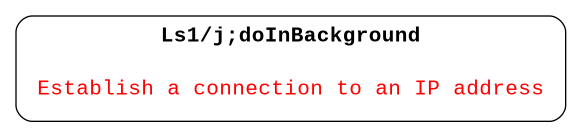
The behavior map reveals that the Ls1/j;doInBackground function establishes a connection to an IP address, which could be a malicious C2 server.
Behaviors detected by Quark:
Establish a connection to an IP address (#00247)
2. Read the payment data of NFC cards
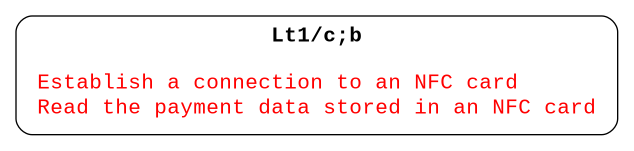
The behavior map reveals that the Lt1/c;b function establishes a connection to an NFC card and reads the payment data stored in it.
Behaviors detected by Quark:
Establish a connection to an NFC card (#00248)
Read the payment data stored in an NFC card (#00249)
3. Captures PINs of NFC cards through deceptive screens
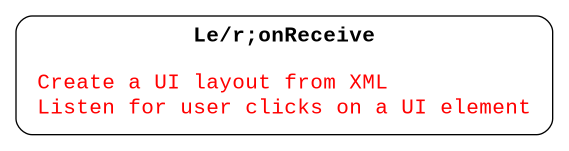
The behavior map reveals that the Le/r;onReceive function creates a UI layout and listens for user clicks on a UI element. If the UI layout is deceptive, users could be deceived into entering their NFC card PINs. Subsequently, the app could harvest the PINs by listening for user clicks on UI elements such as keypad buttons.
Behaviors detected by Quark:
Create a UI layout from XML (#00250)
Listen for user clicks on a UI element (#00251)
List of Tested APKs
The table below lists the APKs we tested.
index |
sha256 |
|---|---|
1 |
0d5fd1997ecb76a167df753d5cce7688dfd0d813c028c9644025da352af77b7d |
2 |
21c66fe505f2bcd7b29d413189920b3a85df48da0ecf4eb6962d6a504a7fdcd8 |
3 |
2922fcf373e2caf3588266cfafeaafbc74304c81d024315d279f0ea537adc1b6 |
4 |
360966ad8752d040e9aaae5cb4a5913e6f85edcf56ecfeb8246729b45d0e6c78 |
5 |
5769ae3cc93943dda4d1743f2febf6cec1282a0a6289da68cb55bb4724ec9332 |
6 |
a78ab0c38fc97406727e48f0eb5a803b1edb9da4a39e613f013b3c5b4736262f |
7 |
ab2906d88e4f64ec0784ef8fdf132bb7ca9a914c037c3b731803f3adfd7a8f66 |
8 |
cb10953f39723427d697d06550fae2a330d7fff8fc42e034821e4a4c55f5a667 |
9 |
d3f863757e946d117ee7c7b50e480264a2ff1a08e7925bd2de3e6c43182868ed |
10 |
e27579b92fcad2f4fe96db7b5e7a7cdc41754a7cd126fcaf598d3f8d8c21c0f5 |
ToxicPanda Malware Family Analysis Report
New Quark rules (#00252 - #00262) are now available. These rules target ToxicPanda, a malware family that steals financial data via deceptive overlays, remotely controls devices, intercepts one-time passwords, and stay active in the background. Check here for the rule details.
With these rules, Quark is now able to identify the ToxicPanda malware family as high-risk. In our experiment, Quark achieved 100% accuracy and 100% precision. Please check here for the APKs we tested.
Below is a summary report of a ToxicPanda sample (12d94320a25c1496ae3c7d326e07d4d92d34381d7b821f58ef9f4e135612c6d8). The report shows that Quark identified the sample as high-risk, with a list of behaviors as evidence.
Identified Well-Known Threats
With Quark’s rule classification feature, analysts can generate behavior maps and see how behaviors are related. This feature helps identify 4 well-known threats from ToxicPanda, as shown below.
1. Steal financial data via deceptive overlays

The behavior map shows that the Lnp/;run function creates a overlay on top of other application by gathering screen information and calling Lnp/ࢯ;̐. To make the overlay deceptive, it displays a website within the overlay and allows the website to access internal methods, enabling the theft of financial data.
Behaviors detected by Quark:
Get the status bar height (#00256)
Get the navigation bar height (#00257)
Create an overlay window on top of other applications (#00252)
Allow website to access internal methods (#00258)
Display URL content on a WebView (#00259)
2. Remotely control device
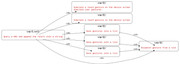
The behavior map shows that the Lnp/Ī;call function retrieves data from a URL and calls multiple functions (Lnp/;̓, Lnp/;̐, Lnp/;̒, Lnp/;̎, Lnp/ࣼ;̔, and Lnp/;̍) to simulate user gestures. If the URL points to a remote server, threat actors can use this mechanism to remotely control the device.
Behaviors detected by Quark:
Query a URI and append the result into a string (#00190)
Simulate a touch gesture on the device screen (#00205)
Simulate user gestures (#00240)
Save gestures into a list (#00253)
Dispatch gesture from a list (#00260)
3. Intercept one-time passwords
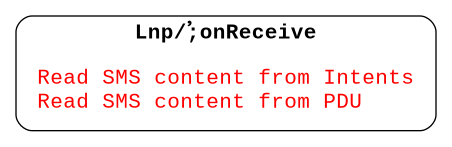
The behavior map shows that Lnp/ࣿ;onReceive reads incoming SMS messages. This enables the malware to intercept SMS-based one-time passwords (OTPs) and bypass two-factor authentication on financial accounts.
Behaviors detected by Quark:
Read SMS message from Intents (#00254)
Read SMS message from PDU (#00261)
4. Stay active in the background

The behavior map shows that Lnp/ࣿ;onReceive monitors device boot events and calls Lnp/ࣿ;̍ to schedule a periodic job. If the job starts the malware, this mechanism allows the malware to stay active in the background after the device boots.
Behaviors detected by Quark:
Monitor device boot completion (#00262)
Schedule a periodic job (#00255)
List of Tested APKs
The table below lists the APKs we tested.
index |
sha256 |
|---|---|
1 |
12d94320a25c1496ae3c7d326e07d4d92d34381d7b821f58ef9f4e135612c6d8 |
2 |
2bf76945694c257d9bb1533c70075fbabce2d8671b476b7478421389ed258980 |
3 |
377f07b92d33e0ea9d7cfe3c288e19df2be8555154bdb1141b82a87d068a0cf7 |
4 |
86fdfff09f03b0cde4cd0cde3ce0f75e37859925ef6fd89b372bbfada1ace572 |
5 |
9d00052eb9a97a53a49c8e1a26138de835e2d354adef44a51ce8fb599d769fc1 |
6 |
d40e45359546cb801887a38d4adb397327ce4bf0a166192f5f72165471fff10d |
7 |
fde931224d2e558e67ac8c9c0c1d0aac4f7562622a67870d6c3024bdeb851676 |
Hydra Malware Family Analysis Report
New Quark rule (#00263) is now available. This rule targets Hydra, a banking trojan family that intercepts SMS messages to capture OTPs, performs overlay attacks to steal banking credentials, communicates with C2 servers for remote control, and collects device fingerprints for tracking. Check here for the rule details.
With this rule, Quark is now able to identify the Hydra malware family as high-risk. In our experiment, Quark achieved 100% accuracy and 100% precision. Please check here for the APKs we tested.
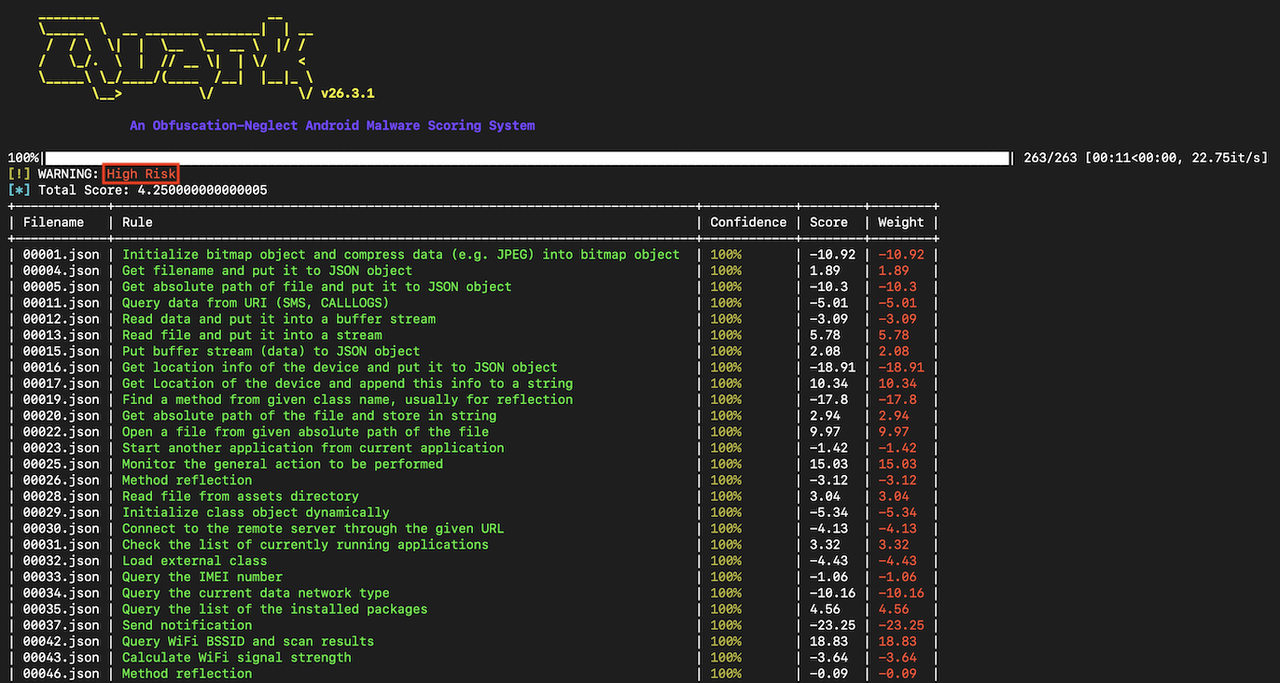
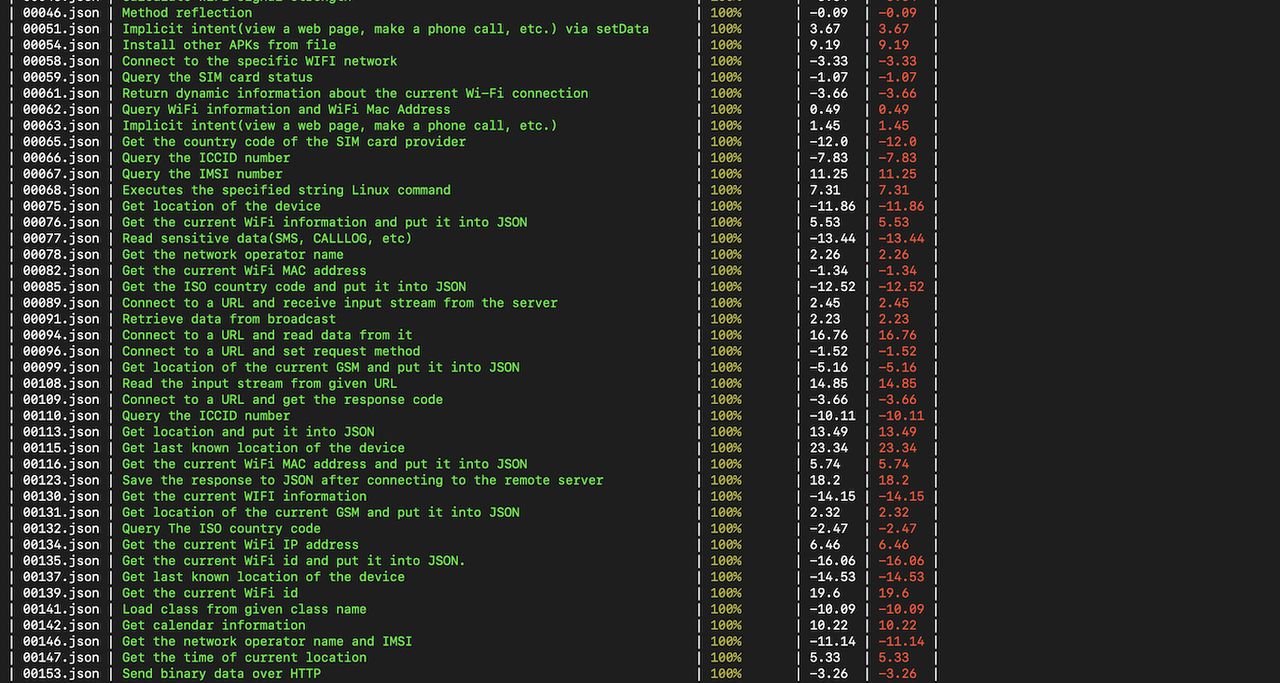
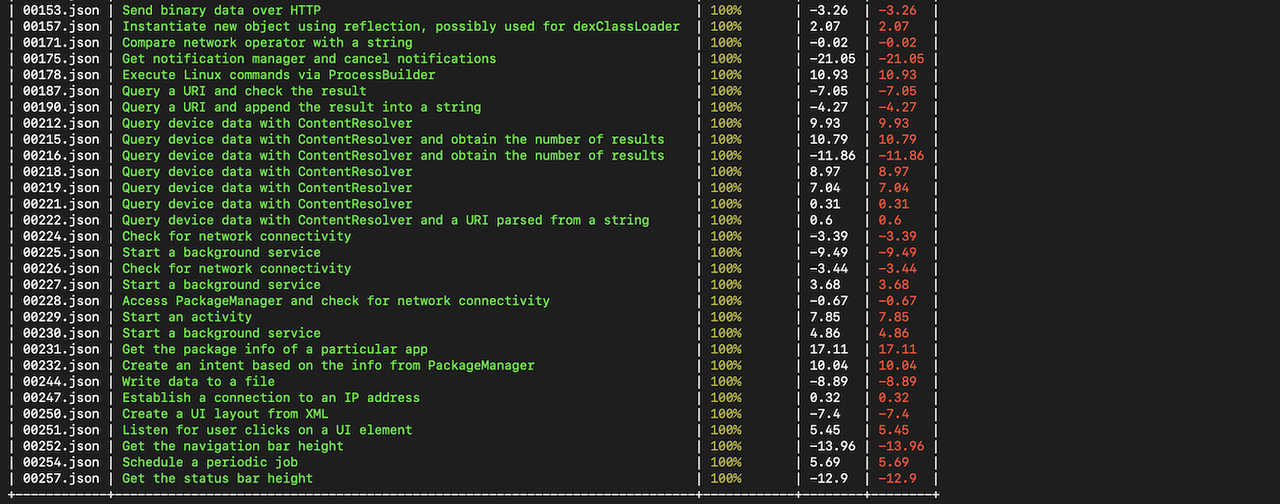
Below is a summary report of a Hydra sample (3154684c4192a1ae7a00f9f61d3024e2d25a85508c512094a771f878c3130848). The report shows that Quark identified the sample as high-risk, with a list of behaviors as evidence.
Identified Well-Known Threats
With Quark’s rule classification feature, analysts can generate behavior maps and see how behaviors are related. This feature helps identify 6 well-known threats from Hydra, as shown below.
1. Intercept SMS messages to capture OTPs and banking codes
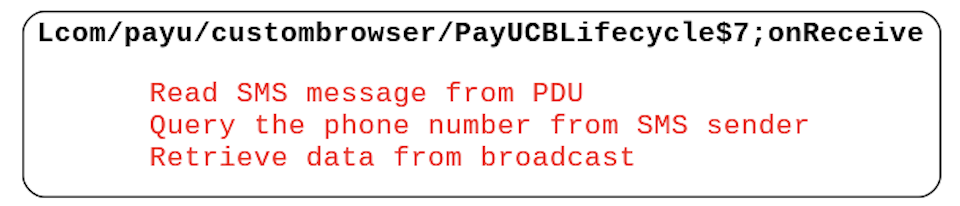
The behavior map shows that the Lcom/payu/custombrowser/PayUCBLifecycle$7;onReceive function reads SMS messages from PDU format, queries the phone number from the SMS sender, and retrieves data from the broadcast. This behavior is commonly used by banking trojans to intercept one-time passwords (OTPs) sent via SMS.
Behaviors detected by Quark:
Read SMS message from PDU
Query the phone number from SMS sender
Retrieve data from broadcast
2. Overlay attacks to deceive users into revealing sensitive information

The behavior map shows that the Lcom/mopub/mobileads/BaseWebView;clearWebViewDeadlock function retrieves the application context and adds a view to the window manager. By adding a view through the WindowManager, the APK can display an overlay window on top of other applications, potentially mimicking a legitimate banking app to steal user credentials.
Behaviors detected by Quark:
Retrieve the application context and add a view to the window manager
3. Communicate with C2 servers for remote control

The behavior map shows that the Lcom/ufotosoft/ad/utils/CachedBitmapFactory;decodeBitmapHTTP function calls Lcom/ufotosoft/ad/utils/HttpUtil;decodeBitmapHttp, which connects to a remote server through a given URL and reads the input stream. This behavior is commonly used for C2 communication, allowing attackers to send commands and receive stolen data.
Behaviors detected by Quark:
Connect to the remote server through the given URL
Read the input stream from given URL
Connect to a URL and get the response code
Connect to a URL and receive input stream from the server
Connect to a URL and read data from it
4. Collect device fingerprints for tracking
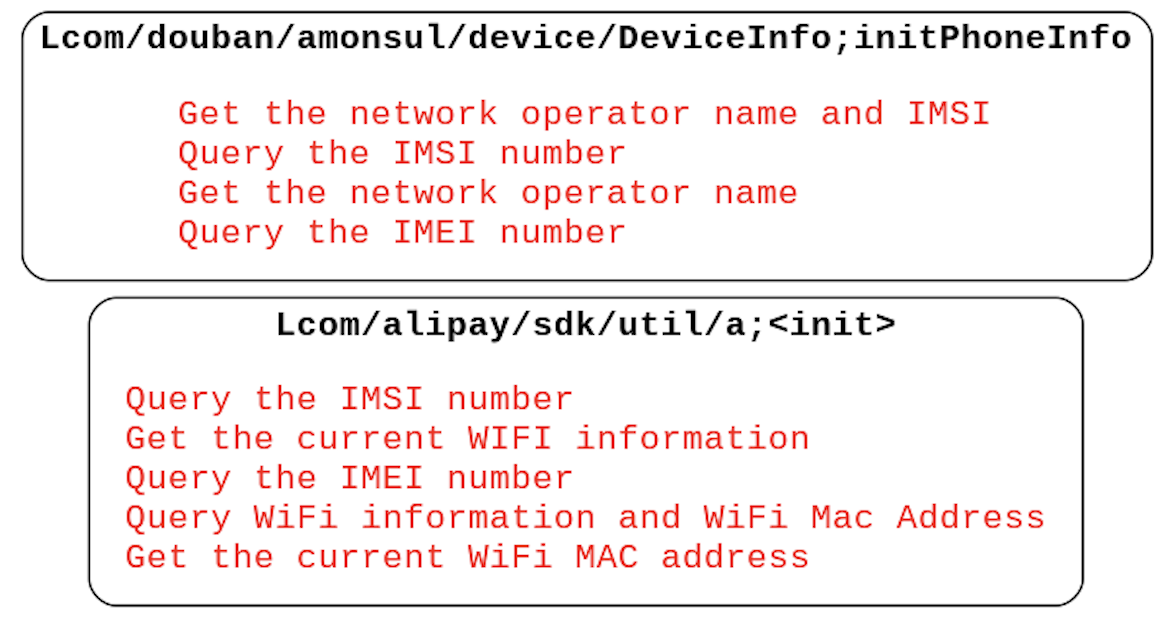
The behavior map shows two functions collecting device identifiers. The Lcom/douban/amonsul/device/DeviceInfo;initPhoneInfo function queries the IMEI number, IMSI number, and the network operator name. The Lcom/alipay/sdk/util/a;<init> function queries the IMEI number, IMSI number, and WiFi information including the MAC address. These identifiers can be used to uniquely identify and track infected devices.
Behaviors detected by Quark:
Query the IMEI number
Query the IMSI number
Get the network operator name and IMSI
Get the network operator name
Get the current WIFI information
Query WiFi information and WiFi Mac Address
Get the current WiFi MAC address
5. Detect foreground applications to trigger overlay attacks

The behavior map shows a transitive call chain: Lcom/igexin/push/extension/distribution/basic/a/a;a and Lcom/igexin/push/extension/distribution/basic/a/a;b both call a intermediate function that uses reflection and dynamic class loading, which in turn calls Lcom/igexin/push/extension/distribution/basic/j/c;b to check the list of currently running applications. This is a prerequisite behavior for overlay attacks — when a targeted banking app is detected in the foreground, the malware triggers the overlay to display a phishing screen.
Behaviors detected by Quark:
Check the list of currently running applications
Instantiate new object using reflection, possibly used for dexClassLoader
Initialize class object dynamically
Start a background service
Send notification
Method reflection
6. Inject JavaScript into WebView for credential harvesting
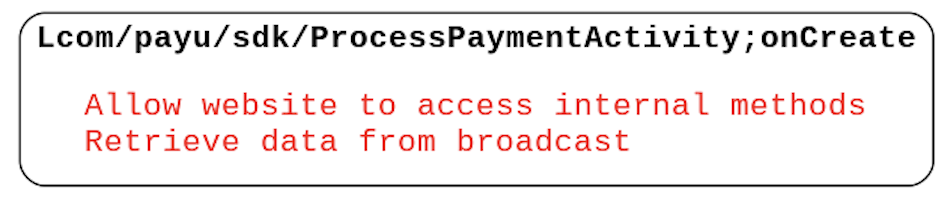
The behavior map shows that the Lcom/payu/sdk/ProcessPaymentActivity;onCreate function allows a website to access internal methods and retrieves data from a broadcast. By injecting a JavaScript interface into a WebView, the malware can interact with web content displayed in the WebView, potentially modifying banking pages or extracting form data entered by users.
Behaviors detected by Quark:
Allow website to access internal methods
Retrieve data from broadcast
List of Tested APKs
The table below lists the APKs we tested.
index |
sha256 |
|---|---|
1 |
2d0b157e27359bc36c31e3c3ef891964bc98b2cb66c4f95c2ffc4af7d3477e30 |
2 |
3154684c4192a1ae7a00f9f61d3024e2d25a85508c512094a771f878c3130848 |
3 |
49bca7195e05926210f7dffe4289f6b30372db9de7af72bc6a4802cb477e5729 |
4 |
5c128cfee50059349b9b155c417e3950aaf292f4a9098e1b6748524e5fdfa6de |
5 |
6005f5569a6240c36f07de53438df1615ea6f000000fa5452d5a8870afe6336b |
6 |
74f3a191e941c68bbc7bf87515a12ae547e79eba4d9ffd5c2799a9c44b77dc2d |
7 |
91126eea4f088df8a38667eff9f0fd8b6d49a58b919e8cfd242612a44d702b40 |
8 |
a2c91743a0834cd1fb63c6965c581e1f5a57f1d2fcb226985423894ac814c93a |
9 |
c08903e2be8737c3fbea2293c6a1a5242afe58e6e90a3da45724a1dae7c88a25 |
10 |
c2ef244e7a1980880aeb212672705e877851b9cc054e023015dd748c8e69ab38 |
11 |
d5a63c4ace387cff8d641ad9aeedf9e406684b0f3bdcfc79e97de80eef177bee |
12 |
e51f32dbe18d52eafe2ac65f77f84450fd279fecd0278b0df95ce654017dddd2 |
13 |
e80cb43578f6a8b2ded95c8a2e86076f3661d60e2f18ebd1f094308e1d593c87 |
14 |
ea6058517e957895fbd3c26cac63013df3442ceea289123c7afd4bd0b24bea82 |
15 |
f6da0d9f1d74f2f80cd4d69183a78ccc1b3679689419262c9704787cea754726 |
16 |
faaf963fd84d0e7c86f8750115f5291f0692d0aca0f97e151cf4cc870a65d88e |
17 |
fb34414b386d0d12c24d11bce56f087730afc3fbab1ee397182f5dd64183b53b |
18 |
fe9cfc5046c583a7b28fa506cd33e636d27310b14240247625c693444a27336f |
SharkBot Malware Family Analysis Report
New Quark rules (#00264 - #00265) are now available. These rules target SharkBot , a sophisticated Android malware family primarily designed for financial fraud. SharkBot leverages techniques such as overlay attacks and credential theft to compromise user accounts. It has been observed targeting banking applications and employs various evasion techniques to avoid detection. Check here for detailed rule information.
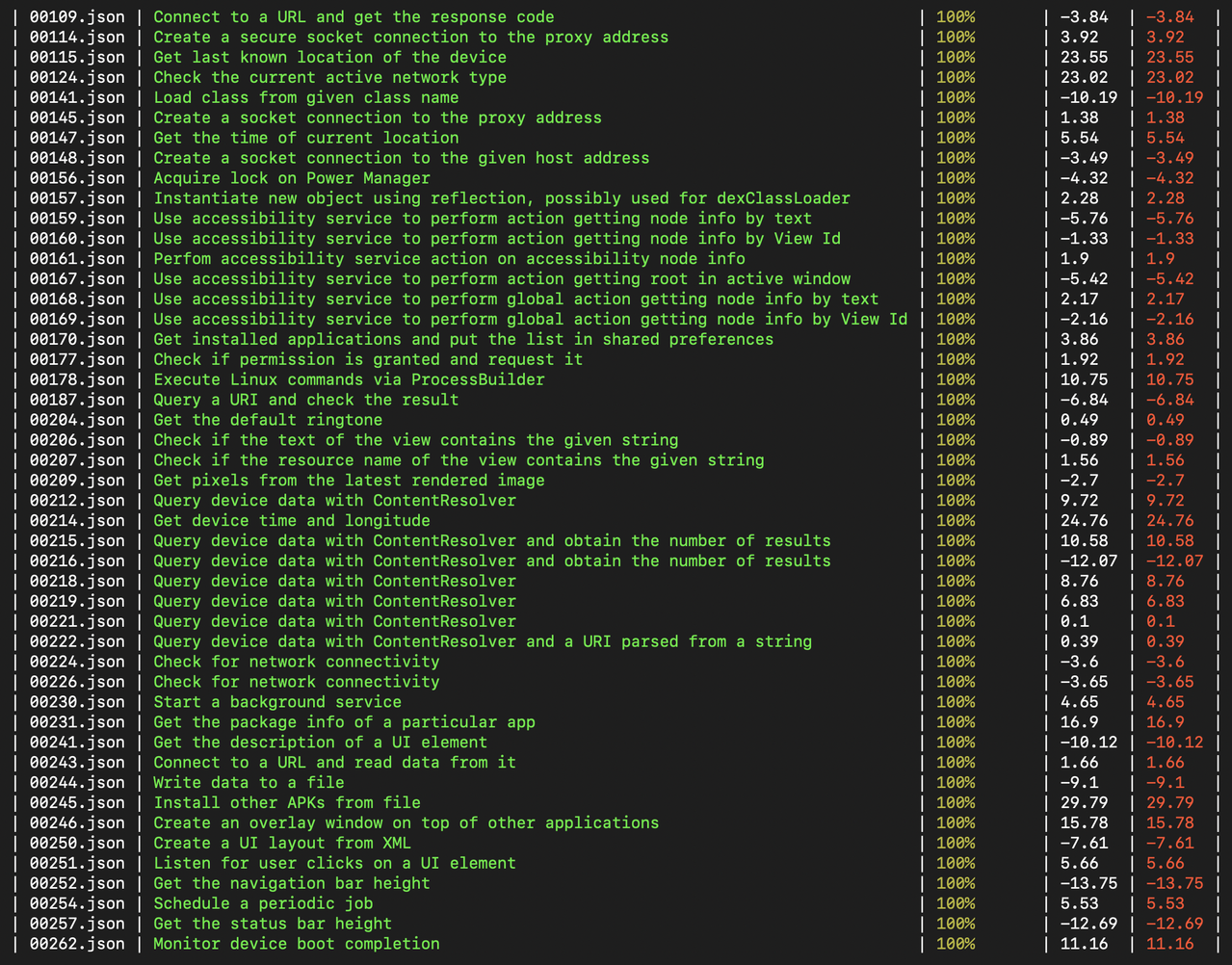
With these rules, Quark is now able to identify the SharkBot malware family as high-risk. In our experiment, Quark achieved 100% accuracy and 100% precision. Please check here for the APKs we tested.
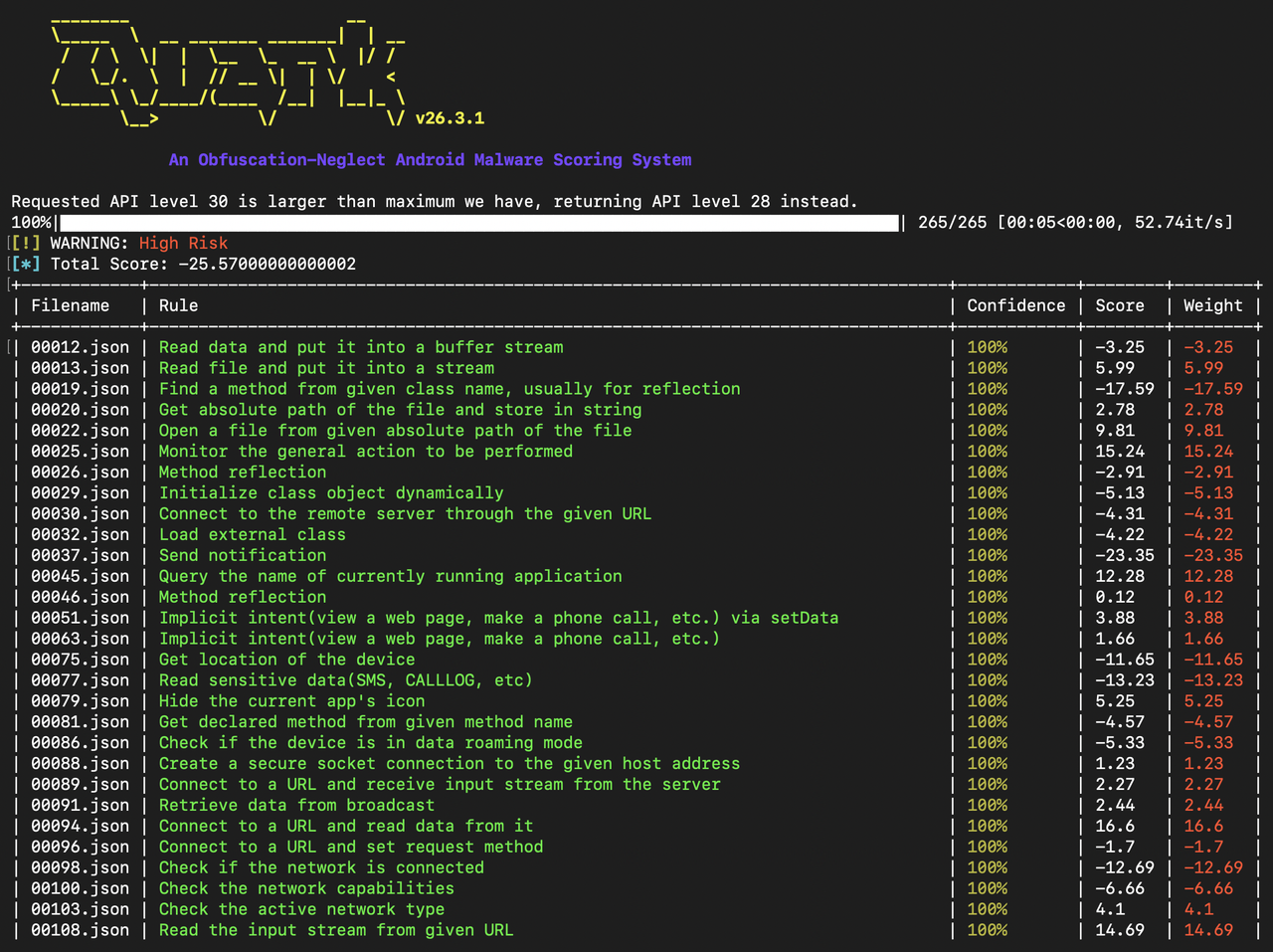
Below is a summary report of a SharkBot sample (20E8688726E843E9119B33BE88EF642CB646F1163DCE4109B8B8A2C792B5F9FC). The report shows that Quark identified the sample as high-risk, with a list of behaviors as evidence.
Identified Well-Known Threats
With Quark’s rule classification feature, analysts can generate behavior maps and see how behaviors are related. This feature helps identify 3 well-known threats from SharkBot, as shown below.
1. Stealing User Credentials

The behavior map shows that the Lcom/guksydvbflaqtwqg2cfuvjwxai7b/ggxfimuhpqlyzg8d2evysfqo/MyServiceA;l function simulates user gestures and queries device data to steal user credentials, calling the Lcom/guksydvbflaqtwqg2cfuvjwxai7b/ggxfimuhpqlyzg8d2evysfqo/MyServiceA;k function to read and compile sensitive data into a JSON object.
Behaviors detected by Quark:
Read sensitive data(SMS, CALLLOG) and put it into JSON object (#00010)
Read sensitive data(SMS, CALLLOG, etc) (#00077)
Query a URI and check the result (#00187)
Simulate a touch gesture on the device screen (#00205)
Query device data with ContentResolver (#00212)
Query device data with ContentResolver and a URI parsed from a string (#00222)
Simulate user gestures (#00240)
2. Intercepting Sms Messages
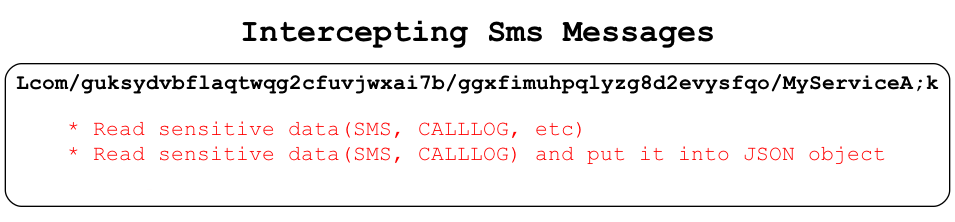
The diagram indicates that the function Lcom/guksydvbflaqtwqg2cfuvjwxai7b/ggxfimuhpqlyzg8d2evysfqo/MyServiceA;k processes SMS-related data and stores it in a JSON object.
Behaviors detected by Quark:
Read sensitive data(SMS, CALLLOG) and put it into JSON object (#00010)
Read sensitive data(SMS, CALLLOG, etc) (#00077)
3. Downloading Additional Payloads

The behavior map shows that the Landroidx/lifecycle/ViewModelProvider$AndroidViewModelFactory;create function uses reflection to instantiate new objects, which may indicate preparation for dynamic code loading via DexClassLoader.
Although no direct download evidence was identified, this pattern can be regarded as one possible indicator of additional payload delivery or loading.
Behaviors detected by Quark:
Instantiate new object using reflection, possibly used for dexClassLoader (#00157)
List of Tested APKs
The table below lists the APKs we tested.
index |
sha256 |
|---|---|
1 |
20E8688726E843E9119B33BE88EF642CB646F1163DCE4109B8B8A2C792B5F9FC |
2 |
4F1822817690D89943E7E57468AB4366E360772C0ADCE67BF74A7224B3732DEE |
3 |
57F8A57320EEED2F5B5A316D67319191CE717CC51384318966B61F95722E275F |
4 |
6AEFC2C4727CE80F03867F356DF462F1A1CE21C72801B877FDB95E67CD00D6A4 |
5 |
7F55DDDCFAD05403F71580EC2E5ACAFDC8C9555E72F724EB1F9E37BF09B8CC0C |
6 |
8F45831B1DF8FE44111E35B05271F6EC1796B03C104A67CD6481BF93F2AFFE86 |
7 |
DD0641F261D75864B164A7F963B45DC43C6C815AD01E5F51C29504C668E6D5EC |
8 |
E5B96E80935CA83BBE895F6239EABCA1337DC575A066BB6AE2B56FAACD29DDAA |
Antidot Malware Family Analysis Report
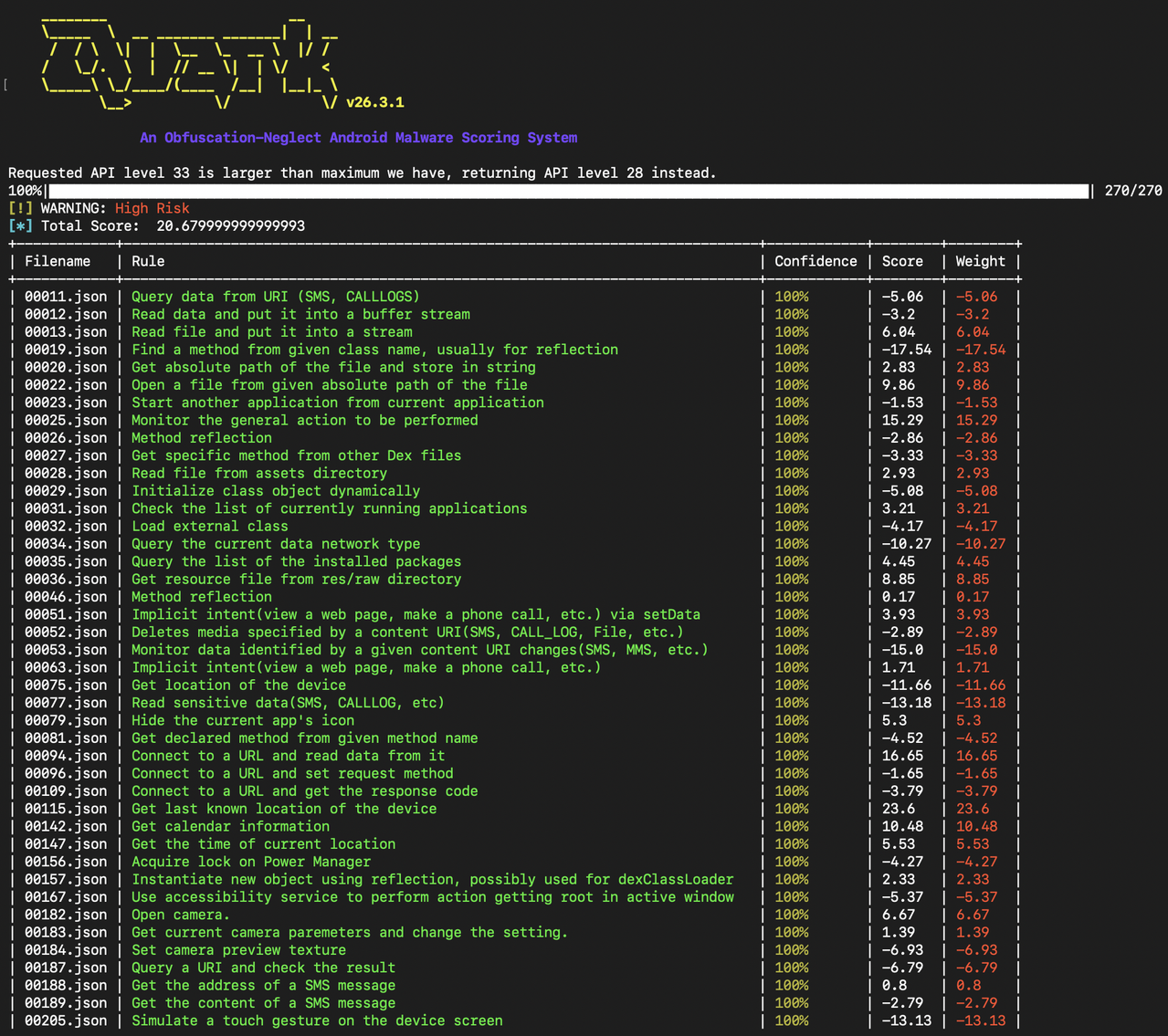
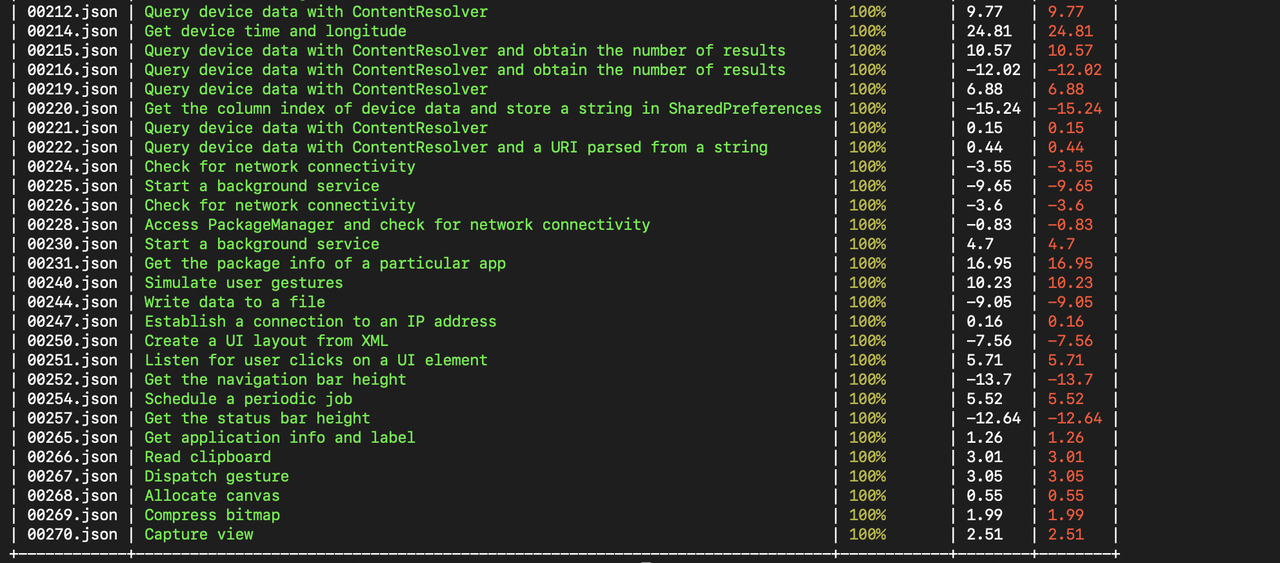
New Quark rules (#00266–#00270) are now available. These rules target Antidot, an Android malware family known for stealing sensitive information and executing a wide range of malicious activities on infected devices. Antidot primarily targets banking applications and leverages multiple evasion and persistence techniques to avoid detection. Check here for the rule details.
With these rules, Quark is now able to identify the Antidot malware family as high-risk. In our experiment, Quark achieved 100% accuracy and 100% precision. Please check here for the APKs we tested.
Below is a summary report of a Antidot sample (07DA124F1F4BA891E7917082BDFA74C580E78543164DF2FEC86E8B0C3AB0211E). The report shows that Quark identified the sample as high-risk, with a list of behaviors as evidence.
Identified Well-Known Threats
With Quark’s rule classification feature, analysts can generate behavior maps and see how behaviors are related. This feature helps identify 4 well-known threats from Antidot, as shown below.
1. Data Theft
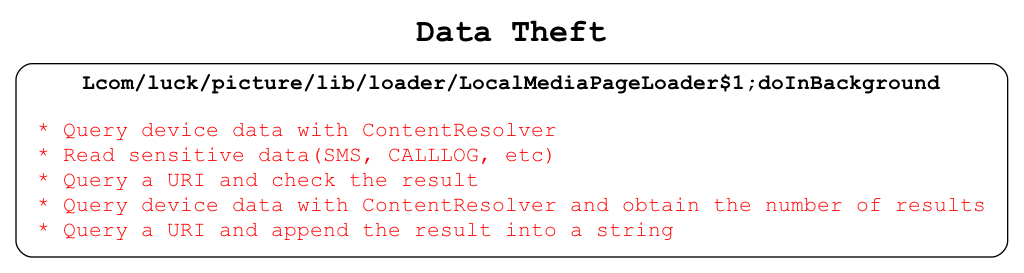
The behavior map shows that the Lcom/luck/picture/lib/loader/LocalMediaPageLoader$1;doInBackground function queries device data using ContentResolver to read sensitive information such as SMS and call logs, and appends the results into a string for potential exfiltration.
Behaviors detected by Quark:
Query device data with ContentResolver (#00218)
Read sensitive data(SMS, CALLLOG, etc) (#00077)
Query a URI and check the result (#00187)
Query device data with ContentResolver and obtain the number of results (#00215)
Query a URI and append the result into a string (#00190)
2. Sms Interception
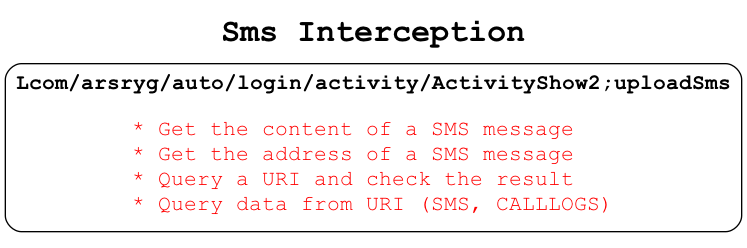
The diagram indicates that the Lcom/arsryg/auto/login/activity/ActivityShow2;uploadSms function retrieves the content and address of SMS messages by querying a URI, facilitating the interception and potential unauthorized access to SMS data.
Behaviors detected by Quark:
Get the content of a SMS message (#00189)
Get the address of a SMS message (#00188)
Query a URI and check the result (#00187)
Query data from URI (SMS, CALLLOGS) (#00011)
3. Keylogging
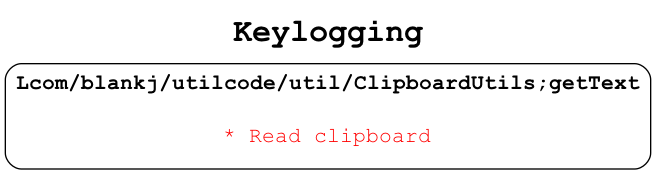
The behavior map shows that the Lcom/blankj/utilcode/util/ClipboardUtils;getText function reads the primary clipboard content, allowing the malware to passively capture credentials and other sensitive text the user copies.
Behaviors detected by Quark:
Read clipboard (#00266)
4. Remote Control
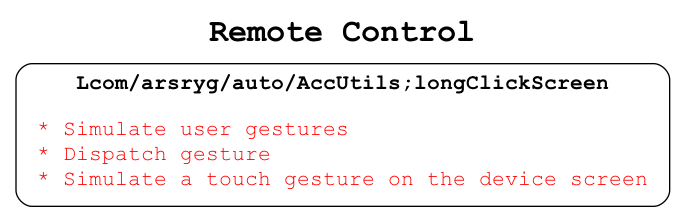
The diagram shows that the Lcom/arsryg/auto/AccUtils;longClickScreen function builds and dispatches accessibility gestures to simulate user input, enabling the attacker to remotely drive the device as if they were sitting in front of it.
Behaviors detected by Quark:
Simulate user gestures (#00240)
Simulate a touch gesture on the device screen (#00205)
Dispatch gesture (#00267)
List of Tested APKs
The table below lists the APKs we tested.
index |
sha256 |
|---|---|
1 |
07DA124F1F4BA891E7917082BDFA74C580E78543164DF2FEC86E8B0C3AB0211E |
2 |
08A646C04974EACA9F50CE5D77FF6216AF5BFF400EC1B48782A4DAE22FEFBEF0 |
3 |
0AF689DA84A03383863583DCAD6C640BA4AB9762AFFDE3D56C199A9EB08E9F41 |
4 |
0B7F4C3BE1D0B0F0B53495FF33E8C4B22ADF122E01F8C72D705C489A975FE498 |
5 |
12D1FC37FBFA5E0EEC3954F5FC31CDBD55AC61EBD84E41C59FF00567D03B107A |
6 |
160940892DC1983ED1B46D8756F1A529D9EC9CE5E3C4481F75C57C568748A38C |
7 |
1AE0C4FFE18E7934C019AD1279219D1E8E8491BF62E8B34102E1497010C58247 |
8 |
2EDC7CBC0DCE61739A4D977ACD8B6E6940A817D4E698CBCCAA8CE1DDBE0A7BBC |
9 |
335FB32EE34E2374D28C9C5A95549FC2965D254B22A9550B505AC7F7304BAE80 |
10 |
4338AB77D05AEACD7EAC5ACBE9EED5568778C8E3E9499562816805B54B4D1A6A |
11 |
476DDA92941E2F211ABC209EA411D97E3007E9434632C0A721AE48F4FE427259 |
12 |
506033F7A6EA5C9E4D89F9EDCC998ED1F33FB74E4A2A4F32AF8CEC2EC009A906 |
13 |
518F74277C26B9CA91A2FE4AEABB26AE9B675A5E2E1BC6BDBE53067183477071 |
14 |
578D3B5DBB35738F47165EE053138021F88C4BEBFE5EBB2B79DBB998600EAA16 |
15 |
6499730A01703CAD20711803829862F3D19EE7A3FEDBE72FEA2F319394B29627 |
16 |
6A99E6D4ABC66F09A490443786432D90C675CB6282C791FAE996136CBB69B7E9 |
17 |
7748CA5B385DB3FDA3E07000B1552CA05405333083B33C4F470DD3AE4F0E3A5F |
18 |
7A373702F30FB4A293574DFF762AB4B89D101DA117F5152BD3BA2369B9DE1661 |
19 |
89CACC44F42639F27EFE324F4937B923E2711B88B67B1FDAE8BBAE1210F573E7 |
20 |
8EA78D335B8B931B49945E3CE36D12B1576647E7FB797840D3D1FA61B2F42200 |
21 |
9DA55AD04E480FA1FD3B45A5F245E6511DFC45D44123000E1CC2D1E10C65E8B8 |
22 |
A2A9FB573C9F39E3654467EFD78C9B5424DE3033303FACAD972DF1A5F8B2FA04 |
23 |
B482C7A2734B90EEA3E35E61962DE17336ED81F26BC9432175A03D4E7DA03D65 |
24 |
BC02322AAF96FA1841101636DC4C8011DA3BCC5571A6F0278813884CE54B5B3F |
25 |
C6E52BD7D8A1DE54E5A6551A7A737C989D93537C1BB440FDF37914C799E77F16 |
26 |
DA7B254CB8877278EC38C674B922D54C2AF67405694823C2A35F12EBF920891B |
27 |
DD4BCE9274CABCBCB2F3EA2B00867932399AD0DE9B923896A70AC03076231EFA |
28 |
E11DBB99B9083326FC1F148C161A5ED9F4B3C59F44C976248C43600334308E21 |
29 |
F3DFED0600935C66C5CB48CA9C4D0CAA65E01545A63CF9256964AF06AA4665AD |
30 |
FE4B2B288565CC1A85B7DD23398CC8AB850B0B0C73D46EC9E7C308AF86A96D60 |
Arsink Malware Family Analysis Report
A new Quark rule (#00271) is now available. This rule targets Arsink. The Arsink malware family is a type of Android malware that targets users through various malicious behaviors, including accessing sensitive device information, initiating phone calls, and extensive Accessibility Service abuse for UI automation. It is often disguised as a legitimate application to evade detection and gain unauthorized access to user data. See the quark-rules repository for the rule details.
With these rules, Quark is now able to identify the Arsink malware family as high-risk. In our experiment, Quark achieved 100% accuracy and 100% precision. Please check here for the APKs we tested.
Below is a summary report of an Arsink sample (48f19eef9d420137dee9974e3cc6af3ded9532bd631ace36f7d15eebec6a2dce). The report shows that Quark identified the sample as high-risk, with a list of behaviors as evidence.


Identified Well-Known Threats
With Quark’s rule classification feature, analysts can generate behavior maps and see how behaviors are related. This feature helps identify 3 well-known threats associated with Arsink, as shown below.
1. Accessing Sensitive Information

The diagram indicates that the LSay/hello/To/Arthur/FileUtil; convertUriToFilePath function works in conjunction with LSay/hello/To/Arthur/FileUtil; getDataColumn to access sensitive information, e.g., image, video, audio, and download file paths, from content resolver.
Behaviors detected by Quark:
Query data from URI (SMS, CALLLOGS) (#00011)
Read sensitive data (SMS, CALLLOG, etc) (#00077)
Query device data with ContentResolver (#00212)
Query device data with ContentResolver and a URI parsed from a string (#00222)
Accessing sensitive data from content provider (#00271)
Check if the device is in data roaming mode (#00086)
2. Initiate Phone Calls

The diagram shows that the Lnet/cloud/analyzer/screen/b;c function uses implicit intents via setData to initiate actions such as making phone calls. This capability enables the malware to trigger phone call operations on the infected device.
Behaviors detected by Quark:
Implicit intent(view a web page, make a phone call, etc.) via setData (#00051)
3. Accessibility-Based UI Control

The behavior map shows that the Ld/g;i function orchestrates UI automation by calling multiple helper functions (Ld/g;x, Ld/g;p, Ld/g;y) that leverage accessibility services to interact with UI elements. These functions perform actions such as getting root windows, finding nodes by View ID and text, retrieving screen bounds, and executing actions on accessibility nodes to enable comprehensive UI automation.
Behaviors detected by Quark:
Use accessibility service to perform action getting node info by text (#00159)
Use accessibility service to perform action getting node info by View Id (#00160)
Perform accessibility service action on accessibility node info (#00161)
Use accessibility service to perform action getting root in active window (#00167)
Use accessibility service to perform global action getting node info by View Id (#00169)
Get bounds in screen of an AccessibilityNodeInfo and perform action (#00173)
List of Tested APKs
The table below lists the APKs we tested.
index |
sha256 |
|---|---|
1 |
06F7DFDFBFF03719082750FB11CA1F1FE720DAA57F11C7D30D3B3277BFECEB13 |
2 |
0BCDF887E6BD21EA4073385A8B2E59025768BE3131A92E9940886E05C748E1CC |
3 |
16CB7952AB3CE88EC30B57E1C5F16A8871457E9985D43675AAE47D8DDB5044C8 |
4 |
1FC3BA39F0CE8109BCB4F42441250DF5E9C601744B738A2E7C40D612CD29FEC3 |
5 |
2063030918DF932A61673559F99E51CC47F3436337F94AFB2E8ACAAFA84289FF |
6 |
2C0BCE17BC9BBFBEA95E5B75E6294FD1D5205B915B24729D1F2377E2A6F2B578 |
7 |
35F06F91902FAF5A4BC27C8B73F74B74AEA6A6BE2215AE1E990EE504CEB29E4F |
8 |
3AE188387DD8B01CD5595B9AD937DAE48D90C4D17FA8BA7F85D3A1F34D1EF3C8 |
9 |
3E6EDEBC2DA9A4A80507EEB7ABF529C9C3A70201927F1AE864F9F257CA64BC2E |
10 |
4070678717CF011417C9E4307C9ECB4D481563DB4758FFAADA5FA6870E06A4AC |
11 |
48F19EEF9D420137DEE9974E3CC6AF3DED9532BD631ACE36F7D15EEBEC6A2DCE |
12 |
4CF809B14083143E921BD8FDB7E7725E20E303653D9A3E6C848D9596A33F6C8E |
13 |
501E35F1600CE0548226C9957EED76F5F04CB2E1DBFD4F3FB8652009B38E8C9F |
14 |
5948A349B534156F5734B3A99E761EC6D84E527AB729B1F28242049B3AFAB2E6 |
15 |
595355DAAA6AAD284090210CD55C4A2E276C5263C83D2B202E1486D347AF3701 |
16 |
5E48BBE1C62DA18D4C0F2CCA0F8855219C5A05F81C5FB64C1B4A0A6871FA8736 |
17 |
603D89C5A2883AB2ED68E12517212BD0B74760F1EF755A61D059440AEBA045FD |
18 |
68F800FBED83116AC9EFB2524326FA5D710A911B506762D580A34C19932A21E8 |
19 |
6D06806CCEE64D3BAA5B9DA63019C3AC7A23DFE210747FBDBC048A84196325C5 |
20 |
744346BD46F139837BF2825206FA95D48DDF6DC078E341492B34B35743A0B297 |
21 |
76B8569EFF05CE94BA580E10FB1161AF6537D931F8C9D07EDBA20E93A4A34BB6 |
22 |
7DDD3C4808372C91C916C4B77A07A09F61753BC26A592FF7DA3BD71D12802A0C |
23 |
8159C79C8A9B54AD363516F9B53C7CADA3EA4AFA0B2D0F6E7DC66FE147D03A93 |
24 |
8314ECE95207FF28466D4FC8BF6CEF22CC6E28FEF47E9BEDE381B502F038B552 |
25 |
89D492B7539B5552445764907A96B517D08D448F8FF0E3E7A93958DF82D3DF58 |
26 |
8E9C6AA5EA90DDD2C3199128E41DE82C4D406B3D2D32BA34CF9D6B1F9C5A8F26 |
27 |
917CDE4F5DFDE864C07A412E586E218F65826B71810083BFFB086C3518DEC645 |
28 |
9A778FBB730EE653F45B36700A369C81792509F855C2529ACA73DE1443C62DE8 |
29 |
9FB8A940492EE6095A24B4A34ECFA252A515FB681F16636A8F00B1E0E7D47FE2 |
30 |
A3F487BBE5AC9A9EB3556E9612C7A16177EA2767783E9401A6643765B1EE39B3 |
31 |
BA71C7E507E1B0D8202447F9F86F585286B4AB01B58C7E32BB4F495381EF5004 |
32 |
BBB41EC382738C0EE5B94D023F023209928CA98893F146A8CFDAA608AFE7B4E6 |
33 |
C002E68F52DE1B2B62013A82828245D8A956A075B87E220C3F6E1B2BFB220D19 |
34 |
C1183C6868BF4E006BA412A538A3A07DADBAEDED2BE6F148765DECF69DC284EC |
35 |
C4F51CCDE0525887B61FB919EEFC5830B24EC35FDCB2AF2AA3893E5F56957C40 |
36 |
CB93D5C96AE3E0B358AC2A0C57008A5655A049AC3BC5543F814AF5157E2F27DE |
37 |
D41329E084AD90A62C37E906F18E1089002F4D5E7C5CE123F7753DA90E410372 |
38 |
D41A27EE5D4B12F6C94E73CC453C69B20FF92CE29823B0FF5BCC50C0D61F826E |
39 |
D5B6C048A278C06E2625C47A3A57F5CE2E4D6D73D830051A84DE1768E0445882 |
40 |
D7362FF697A5CAE24B4B084D0436CCDE7060524A24C34F37F185F64597930514 |
41 |
DB5B22F8D3400BAFA449B6DB01F44896DD8040733B03D11DBC187146E58DFBCD |
42 |
EB76F62F4BA0718AFD9B1BCCCD6389A6043A4394A6769730F75F8E1F8B3752AF |
43 |
F9B00165598A0600D53064B2871477FEC3BD62549A69328C4BDD39467AF2D48D |
44 |
FD263056ADFE6CB5596A11612440FA5D851B3B9BED34A481139C2206A6C570B1 |
TrickMo Malware Family Analysis Report
New Quark rule (#00272) is now available. This rules target TrickMo. See the quark-rules repository for the rule details.
TrickMo is an Android banking trojan that evolved from the TrickBot ecosystem. It primarily intercepts SMS messages for 2FA bypass, and employs accessibility service abuse for screen recording and credential theft. The malware uses sophisticated evasion techniques and has been identified since 2019.
With these rules, Quark is now able to identify the TrickMo malware family as high-risk. In our experiment, Quark achieved 100% accuracy and 100% precision across 29 tested APKs. See here for the list.
Below is a summary report of a TrickMo sample (4284e6bbc2fc274d8b0a1f37f91408efc0404e4cae0ba28abc4d583bc59af6bd). The report shows that Quark identified the sample as high-risk, with a list of behaviors as evidence.


Identified Well-Known Threats
With Quark’s rule classification feature, analysts can generate behavior maps and see how behaviors are related. This feature helps identify 6 well-known threats from TrickMo, as shown below.
1. SMS Interception for 2FA Bypass
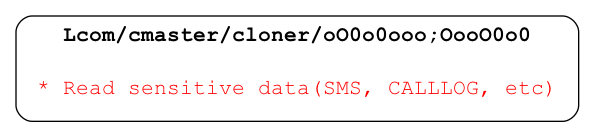
The Lcom/cmaster/cloner/oO0o0ooo;OooO0o0 function queries sensitive data, e.g., SMS and call logs via content provider. In a banking-trojan context, this behavior is consistent with silently reading incoming SMS messages to intercept one-time passwords (OTPs), defeating SMS-based 2FA.
Behaviors detected by Quark:
Read sensitive data (SMS, CALLLOG, etc.) (#00077)
2. Screen Recording and Screenshot Capture

The Lcom/cmaster/cloner/oOO00ooO;OooOO0O function allocates a canvas around a bitmap and renders a target view’s contents into that off-screen bitmap. This pattern lets the malware silently capture the rendered UI it can reach — including banking-app screens displaying account numbers, balances, or OTPs — without triggering Android’s MediaProjection consent dialog.
Behaviors detected by Quark:
Allocate canvas (#00268)
Capture view (#00270)
3. Persistent Background Service

The Lcom/amazon/device/iap/internal/c/e;a function starts a background service. A persistent background service keeps the malware active beyond the app’s foreground lifetime, enabling the continuous device surveillance commonly associated with TrickMo’s accessibility-service abuse.
Behaviors detected by Quark:
Start a background service (#00225)
4. Device Information Exfiltration

The Lcom/inmobi/media/tk;a function, together with 4 callee functions, collects GPS coordinates, network operator identity, ISO country code, network connectivity state, and calendar data. This breadth of collection produces a comprehensive device snapshot consistent with the reconnaissance stage of a banking trojan attack.
Behaviors detected by Quark:
Get location of the device and append this info to a string (#00017)
Query the network operator name (#00060)
Get the ISO country code and put it into JSON (#00085)
Check the current network type (#00087)
Check the network capabilities (#00100)
Get location and put it into JSON (#00113)
Get last known location of the device (#00115)
Check the current active network type (#00124)
Query the ISO country code (#00132)
Get calendar information (#00142)
Get the time of current location (#00147)
Compare network operator with a string (#00171)
5. Reflection-Based API Obfuscation
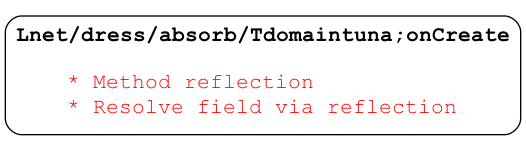
The Lnet/dress/absorb/Tdomaintuna;onCreate function dynamically resolves method calls and field accesses at runtime via Java reflection. Together, these behaviors hide the complete set of Android APIs and data fields the malware accesses from static analysis — a known evasion technique in TrickMo.
Behaviors detected by Quark:
Method reflection (#00026)
Resolve field via reflection (#00272)
List of Tested APKs
The table below lists the APKs we tested.
index |
sha256 |
|---|---|
1 |
04CB1225B4A5A0C256234A9B027408994C45911041766FE0B7E691C44A29389D |
2 |
0E69F3D10BA88974C47A9CE83A095A29E9AC3DE66B0441DB60624FBE0772F6C3 |
3 |
11AF0DA9A7C5F65BB098ED52973E814B12EBA492FB3615A5FADA5D4CC390928D |
4 |
17FC5D1C8BD8B10471131282E42EC289BB1E1EE107CA676F369BB42FC3643AF3 |
5 |
1E386AFECBBF96D119876DC5FD54382FEB0FAE878A416321E4ED3A897E763F4F |
6 |
2CDFB07D6CAD4B2DCBBDB2713A99AE70DCDD2C049D2E3B356DE4609A905E500A |
7 |
2E6C7354F7B4DCE59752054929731C5055DF15301ED094820BDBBCD5C0CFA12E |
8 |
3FB75B18F25919C3FC2E2D60905214C432CAF182D3A600F2CA68E3B1BBCF3575 |
9 |
4284E6BBC2FC274D8B0A1F37F91408EFC0404E4CAE0BA28ABC4D583BC59AF6BD |
10 |
4FCCE7C445D89D7DE943EC0E0C2FC285D4B25A67950AD7D6BCB50DBCBC4AC29B |
11 |
5489C3F1F561E1F7FA68F7A6041FBA8AED8F682095E1F50B07B4B91AC284E9BD |
12 |
57940C5EEE8641E02F49D1122528665A0DDFBF5B6B0D4B910B5287E15542591D |
13 |
5885804AC3FBD9A06595B9314B77898747B2F9B8A7624F72D402F5D5C5BAAC68 |
14 |
6EB525100F54B9A830CD2D0F1169B053EDB55332B2BE73DD29A8B165B9CCDBF5 |
15 |
6F58B07B5DDABC29C9C7E7165349EDBD2BEE923446514044D67040DE2F36664A |
16 |
7593B0F4BC4C52CB359196F35868636B319641B01C8DB9F662076285739A0505 |
17 |
7B1FA1AC136469CA0CF8E0B80830876185E9858A168098A093AAF43319FC60A7 |
18 |
963A61A8ECA4378566CE39113DDBCB08EE961EF54C274068E62EFC9201FAD1CC |
19 |
9A5182C4F9B3061D30652264096D225CE16CB5C962E1C67ED153E3986D9E05C8 |
20 |
A7FD4A7AD1B5F67F588CFCDC7BB092D1C8AED71FFC9402F618F4562C3DADF8E1 |
21 |
ABA8466F8162846C8ADC7BE242BB78A346775804DE2C14A978D69649B0639C6D |
22 |
AC21DDC972B50C66A9876F1A470F0A29F4DF58C1557B8FA0BA649FC0B255DD37 |
23 |
B1A8A189A95DFE33683141BA24F022357B2E60E5A811F5559B3119FE67C17BDC |
24 |
B80C00BC987EA9ACACEC57EEAF299421DA8E083F611084816BF0C015C7088DED |
25 |
B9F0D4A2EA3FD0B0E2A7F3EF024E056AB58F51DD21960DD671DD42ABF81A7B21 |
26 |
C00419B21D10A236B47B43BB1EED3DBC5298E471CF9616848A84DA5BAAE8E611 |
27 |
CEEA4208D55B4DE89279633183DAE164E57AA03D729ADE7D39A75C7D1E583078 |
28 |
CFA37C111D5D86AA348A8411C39FE1C54034C437A5C15777A42638C6A9D03EB0 |
29 |
D0D4EF735A8BF076D81A6F3651D6BCFD8C69285049ADD2E6B6BEE1276A99C37C |
Anubis Malware Family Analysis Report
New Quark rule (#00273) is now available. This rule targets Anubis. Anubis is a sophisticated Android banking trojan that emerged around 2017, targeting financial institutions worldwide. It features overlay attacks to steal banking credentials, keylogging, screen recording, SMS interception, and ransomware capabilities. The malware is distributed through malicious apps on Google Play and phishing campaigns.
In the representative sample, Quark observed the following behaviors at the API level: use accessibility service to query UI elements, read SMS messages, audio recording via microphone, make outbound phone calls programmatically, read and decode file contents, and HTTP communication with remote server. Check here for the rule details.
With these rules, Quark is now able to identify the Anubis malware family as high-risk. In our experiment, Quark achieved 100% accuracy and 100% precision. Please check here for the APKs we tested.
Below is a summary report of a TrickMo sample (13f00206aaed4612ce4655152b972aeb2787ca4133aeacc8c9acd8c4d38ea3f79.apk). The report shows that Quark identified the sample as high-risk, with a list of behaviors as evidence.


Identified Well-Known Threats
With Quark’s rule classification feature, analysts can generate behavior maps and see how behaviors are related. The 6 behaviours below were observed in the representative sample at the API level.
1. Use Accessibility Service to Query UI Elements

onAccessibilityEvent uses the accessibility service to retrieve node information by matching text content. Together, these calls enable programmatic inspection of UI elements displayed in other applications.
Behaviors detected by Quark:
Use accessibility service to perform action getting node info by text (#00159)
2. Read SMS Messages
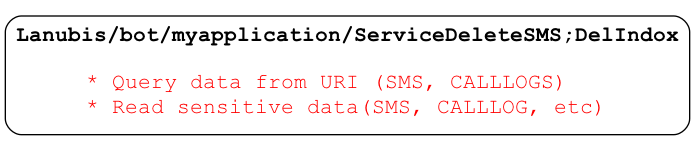
DelIndox queries SMS data from the content provider URI and reads message contents. Combined, these APIs allow the service to access and extract stored SMS messages from the device.
Behaviors detected by Quark:
Query data from URI (SMS, CALLLOGS) (#00011)
Read sensitive data(SMS, CALLLOG, etc) (#00077)
3. Audio Recording via Microphone
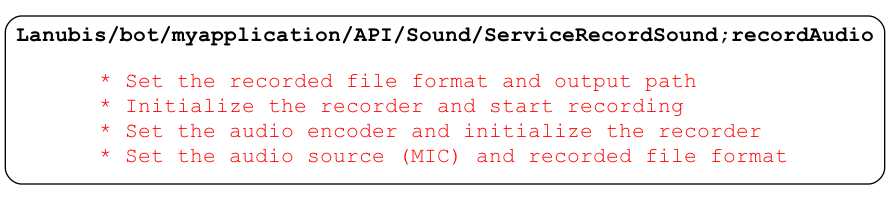
recordAudio configures the audio source, encoder, file format, and output path, then initializes and starts the recorder. Together, these calls capture live audio from the device microphone and save it to a file.
Behaviors detected by Quark:
Set the audio source (MIC) and recorded file format (#00194)
Set the recorded file format and output path (#00196)
Set the audio encoder and initialize the recorder (#00197)
Initialize the recorder and start recording (#00198)
4. Make Outbound Phone Calls Programmatically

onCreate constructs an implicit intent with a phone number and initiates a call action. Combined, these APIs trigger an outbound phone call without user interaction.
Behaviors detected by Quark:
Implicit intent(view a web page, make a phone call, etc.) via setData (#00051)
Make a phone call (#00202)
Put a phone number into an intent (#00203)
5. Read and Decode File Contents

readCommand calls getIDwindowsBot to open and read a file from its absolute path, then decodes the Base64-encoded content and writes it. Together, these calls retrieve encoded file data and persist the decoded output.
Behaviors detected by Quark:
Get absolute path of the file and store in string (#00020)
Open a file from given absolute path of the file (#00022)
Write file after Base64 decoding (#00024)
6. HTTP Communication with Remote Server

doInBackground establishes URL connections, sends POST requests, and reads response streams and status codes. Combined, these APIs enable bidirectional HTTP communication with a remote server.
Behaviors detected by Quark:
Connect to the remote server through the given URL (#00030)
Connect to a URL and receive input stream from the server (#00089)
Connect to a URL and read data from it (#00094)
Connect to a URL and set request method (#00096)
Read the input stream from given URL (#00108)
Connect to a URL and get the response code (#00109)
Send HTTP POST request and receive response (#00273)
List of Tested APKs
The table below lists the APKs we tested.
index |
sha256 |
|---|---|
1 |
30B0B3B0D4733F3B94517AB4E407214E82ABF6AAD3ADF918717FF842E28D672F |
2 |
3F00206AAED4612CE4655152B972AEB2787CA4133AEACC8C9ACD8C4D38EA3F79 |
3 |
63263048A73FD8B6E37431688A331A2A88E8FC86848BFB4BA09751F2E7AB8F5C |
4 |
7138689203DC5A2FE9CFCB84C39885E4B53EEC9A72F37E36DDEE61490F8217CA |
5 |
7CE3D3AA76710A4D70D7DBA0379FDE70724F923E582381AF4AE32365A9B9B516 |
6 |
9B2AF95F9F69CE03DB5C03B13F4F9F69051BB490C968A1C7CA6A9B80D20FDF94 |
7 |
9FC2E5D32B4A4E2886CD835A9DDDD6A2C94C85BF175700A0655A70D422E2DEB8 |
8 |
AD2053BC0CF1CC54C5A0F7E6DE4653B8012BA349219AC56B27E26E6CF2B96077 |
9 |
C7411C0DAFF520468C3ACCFF4318076A66034B2D14CBAE08A5D3ECEC2C6CE9ED |
10 |
D0E684DEDD320A8B1838DAB6C94E97384058FB18B831CEB3F479AEA849D83811 |
11 |
D7511298F5F6C7205EB753ECD7A4E0070E9F4E353F8E6C94EF3339B4A1886B73 |
12 |
E0D3EE34E12845AD99E8E23FD0CFBED54C7640EABEA957337DEC0176D152F837 |
13 |
F57308A3D0A09D0DA95D9055EC76E3DCED8292B47FCD41FEF237EBF7C1AD5F03 |
GodFather Malware Family Analysis Report
New Quark rule (#00274) is now available. This rule targets GodFather. Check here for the rule details.
With these rules, Quark is now able to identify the GodFather malware family as high-risk. In our experiment, Quark achieved 100% accuracy and 100% precision. Please check here for the APKs we tested.
Identified Well-Known Threats
This section uses MITRE ATT&CK Mobile as its reference taxonomy. The table below lists every technique documented for GodFather (per software entry S1231 GodFather) alongside how each manifests in real-world campaigns — all of which the current Quark rule set can detect statically from APK bytecode.
MITRE Technique |
Real-world manifestation |
|---|---|
T1418 Software Discovery |
Enumerating installed banking and cryptocurrency apps to select overlay targets |
T1417 Input Capture |
Harvesting credentials and payment card data via accessibility service keylogging |
T1516 Input Injection |
Automating fraudulent transactions by simulating taps and gestures through accessibility APIs |
T1582 SMS Control |
Intercepting SMS-based two-factor authentication codes to bypass account protections |
T1616 Call Control |
Blocking or redirecting incoming calls from banks to evade fraud alerts |
T1624 Event Triggered Execution |
Launching overlay attacks when targeted banking applications are opened by user |
T1629 Impair Defenses |
Disabling Google Play Protect and preventing uninstallation via device administrator privileges |
All behavior maps below were rendered from sample 0b72c22517fdefd4cf0466d8d4c634ca73b7667d378be688efe131af4ac3aed8.apk — chosen as the representative sample whose detected behaviors most fully cover the documented profile of GodFather. The other 11 family samples were used to compute the accuracy and precision figures above.
Each section below corresponds to one technique from the table above. Within each section we first quote the MITRE definition, then show the Quark behavior map extracted from the representative sample’s bytecode, then walk through the call sequence and list the underlying rules.
1. T1418 Software Discovery
T1418 Software Discovery — attack.mitre.org
MITRE definition (T1418): Adversaries may attempt to get a listing of applications that are installed on a device.

number_task calls getApps to enumerate installed applications and store the list in shared preferences. Together, these calls enable the malware to discover and persist a complete inventory of software present on the device.
Behaviors detected by Quark:
Get installed applications and put the list in shared preferences (#00170)
Enumerate installed applications (#00264)
2. T1417 Input Capture
T1417 Input Capture — attack.mitre.org
MITRE definition (T1417): Adversaries may use methods of capturing user input to obtain credentials or collect information. During normal device usage, users often provide credentials to various locations, such as login pages/portals or system dialog boxes.

onAccessibilityEvent calls two helpers to query UI nodes by ID and text, check view content, and perform actions on accessibility node info. Together, these calls enable automated inspection and interaction with UI elements in the active window.
Behaviors detected by Quark:
Use accessibility service to perform action getting node info by text (#00159)
Use accessibility service to perform action getting node info by View Id (#00160)
Perfom accessibility service action on accessibility node info (#00161)
Use accessibility service to perform action getting root in active window (#00167)
Check if the text of the view contains the given string (#00206)
Check if the resource name of the view contains the given string (#00207)
3. T1582 SMS Control
T1582 SMS Control — attack.mitre.org
MITRE definition (T1582): Adversaries may delete, alter, or send SMS messages without user authorization. This could be used to hide C2 SMS messages, spread malware, or various external effects. This can be accomplished by requesting the RECEIVE_SMS or SEND_SMS permissions depending on what the malware is attempting to do.

onReceive calls SMRC to monitor incoming SMS messages and extract sender phone numbers and message content. Together, these calls enable the receiver to intercept and inspect SMS data as it arrives on the device.
Behaviors detected by Quark:
Monitor the general action to be performed (#00025)
Query the phone number from SMS sender (#00049)
Check if the content of SMS contains given string (#00118)
Monitor incoming SMS message (#00234)
4. T1616 Call Control
T1616 Call Control — attack.mitre.org
MITRE definition (T1616): Adversaries may make, forward, or block phone calls without user authorization. This could be used for adversary goals such as audio surveillance, blocking or forwarding calls from the device owner, or C2 communication.

onCreate constructs an implicit intent with a phone number and initiates a phone call via setData. Combined, these APIs enable the activity to programmatically place outbound calls without user interaction.
Behaviors detected by Quark:
Implicit intent(view a web page, make a phone call, etc.) via setData (#00051)
Make a phone call (#00202)
Put a phone number into an intent (#00203)
5. T1624 Event Triggered Execution
T1624 Event Triggered Execution — attack.mitre.org
MITRE definition (T1624): Adversaries may establish persistence using system mechanisms that trigger execution based on specific events. Mobile operating systems have means to subscribe to events such as receiving an SMS message, device boot completion, or other device activities.

The behavior map above shows GodFather subscribing to the incoming-SMS broadcast — Android’s SMS_RECEIVED is one of the canonical “specific events” called out in the MITRE definition, and the malware uses it as a trigger for persistent execution. onReceive monitors the general action performed and incoming SMS messages, enabling the receiver to detect and respond to SMS arrival events in real time.
Behaviors detected by Quark:
Monitor the general action to be performed (#00025)
Monitor incoming SMS message (#00234)
6. T1629 Impair Defenses
T1629 Impair Defenses — attack.mitre.org
MITRE definition (T1629): Adversaries may maliciously modify components of a victim environment in order to hinder or disable defensive mechanisms. This not only involves impairing preventative defenses, such as anti-virus, but also detection capabilities that defenders can use to audit activity and identify malicious behavior.

The behavior map above shows GodFather deleting SMS and call-log entries via content URIs — a concrete instance of impairing the user’s ability to audit communication activity (matching the MITRE definition’s phrase “detection capabilities defenders can use to audit activity”). DelSent deletes media specified by content URIs, including SMS and call logs, erasing traces of communication activity.
Behaviors detected by Quark:
Deletes media specified by a content URI(SMS, CALL_LOG, File, etc.) (#00052)
List of Tested APKs
The table below lists the APKs we tested.
index |
sha256 |
|---|---|
1 |
0B72C22517FDEFD4CF0466D8D4C634CA73B7667D378BE688EFE131AF4AC3AED8 |
2 |
138551CD967622832F8A816EA1697A5D08EE66C379D32D8A6BD7FCA9FDEAECC4 |
3 |
20116083565A50F6B2DB59011E9994E9A9F5DB5994703D53233B8B202A5AD2F3 |
4 |
3BBEF6F36E2E673DF2620A01463F9B598D0F70C76F450601EC29873D8EBA5B7A |
5 |
3D4F63FC88EC8A4DFC9A5C3FEE1A59DED40BBB2F4F04ED937C135B144E8A166D |
6 |
58D335B2FD86126AB18CFBECD117C7700D154A2473CC1BDD507C0F57FA7052E3 |
7 |
6E0D01C4C547D235C247A6D0719F2ACA2D4996AE78DF4B671275914A9E3FD2D3 |
8 |
75CC07A1AF57D9D2A9A06840A25D1B9B368B1DDD57D98BAC9A5A5F2F4D0D931D |
9 |
9DFB5B4AD9AAC36C2D7FBB93F8668FAA819CB0DF16F4A55D00F1CDDA89C9A6D2 |
10 |
A14AAD1265EB307FBE71A3A5F6E688408CE153FF19838B3C5229F26EE3ECE5DD |
11 |
A6ED100AE42E4FDABFD1B4C992762152BC4A11CC8E521B647B444C75BB7A9782 |
12 |
C2BCCFC8B3BDF2DA5FB5C22055A9C4859256BE7904933E9E0B92FA31FD0420D3 |
TangleBot Malware Family Analysis Report
New Quark rule (#00275) is now available. This rule targets TangleBot. Check here for the rule details.
With these rules, Quark is now able to identify the TangleBot malware family as high-risk. In our experiment, Quark achieved 100% accuracy and 100% precision. Please check here for the APKs we tested.
Identified Well-Known Threats
This section uses MITRE ATT&CK Mobile as its reference taxonomy. The table below lists every technique documented for TangleBot (per software entry S1069 TangleBot) alongside how each manifests in real-world campaigns — all of which the current Quark rule set can detect statically from APK bytecode.
MITRE Technique |
Real-world manifestation |
|---|---|
T1430 Location Tracking |
Real-time GPS coordinate harvesting to monitor victim physical movements and location |
T1418 Software Discovery |
Enumerating installed applications to profile device usage and identify high-value targets |
T1513 Screen Capture |
Capturing screenshots to exfiltrate sensitive on-screen data including credentials and messages |
T1582 SMS Control |
Intercepting and exfiltrating SMS messages including authentication codes and private communications |
T1616 Call Control |
Initiating, redirecting, or blocking phone calls to facilitate fraud or eavesdropping |
All behavior maps below were rendered from sample 7badeb43e25c4bc7772b4e62d97a7bffc84a02b8f50ea83e8ab8acb598a20bad.apk — chosen as the representative sample whose detected behaviors most fully cover the documented profile of TangleBot. The other 8 family samples were used to compute the accuracy and precision figures above.
Each section below corresponds to one technique from the table above. Within each section we first quote the MITRE definition, then show the Quark behavior map extracted from the representative sample’s bytecode, then walk through the call sequence and list the underlying rules.
1. T1430 Location Tracking
T1430 Location Tracking — attack.mitre.org
MITRE definition (T1430): Adversaries may track a device’s physical location through use of standard operating system APIs via malicious or exploited applications on the compromised device. On Android, applications holding the
ACCESS_COARSE_LOCATIONorACCESS_FINE_LOCATIONpermissions provide access to the device’s physical location.

Ld/g$g;c retrieves device time, longitude, current location, and last known location through location services. Together, these calls enable precise geographic tracking of the device over time.
Behaviors detected by Quark:
Get location of the device (#00075)
Get last known location of the device (#00115)
Get device time and longitude (#00214)
2. T1418 Software Discovery
T1418 Software Discovery — attack.mitre.org
MITRE definition (T1418): Adversaries may attempt to get a listing of applications that are installed on a device.
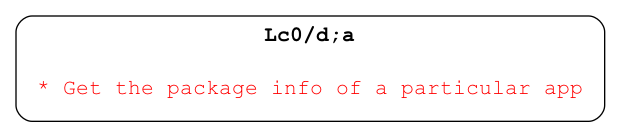
Lc0/d;a queries package information for a specific application installed on the device. This call enables the malware to enumerate installed app details including version and permissions.
Behaviors detected by Quark:
Get the package info of a particular app (#00231)
3. T1513 Screen Capture
T1513 Screen Capture — attack.mitre.org
MITRE definition (T1513): Adversaries may use screen capture to collect additional information about a target device, such as applications running in the foreground, user data, credentials, or other sensitive information.
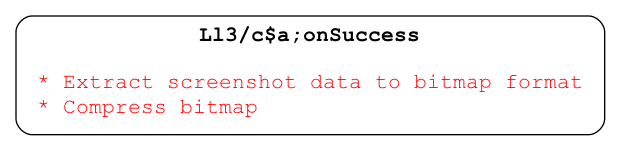
Ll3/c$a;onSuccess extracts screenshot data into bitmap format and compresses the resulting image. Together, these calls capture the device screen and reduce the image’s file size so it can be exfiltrated efficiently.
Behaviors detected by Quark:
Extract screenshot data to bitmap format (#00238)
Compress bitmap (#00269)
4. T1582 SMS Control
T1582 SMS Control — attack.mitre.org
MITRE definition (T1582): Adversaries may delete, alter, or send SMS messages without user authorization. This could be used to hide C2 SMS messages, spread malware, or various external effects. This can be accomplished by requesting the
RECEIVE_SMSorSEND_SMSpermissions depending on what the malware is attempting to do.

Ll3/a;t calls two helpers to query and read SMS and call log data from URIs, then sends SMS messages. Together, these calls enable both exfiltration of existing messages and transmission of new SMS content.
Behaviors detected by Quark:
Read sensitive data(SMS, CALLLOG) and put it into JSON object (#00010)
Query data from URI (SMS, CALLLOGS) (#00011)
Send SMS (#00040)
Read sensitive data(SMS, CALLLOG, etc) (#00077)
Query a URI and append the result into a string (#00190)
5. T1616 Call Control
T1616 Call Control — attack.mitre.org
MITRE definition (T1616): Adversaries may make, forward, or block phone calls without user authorization. This could be used for adversary goals such as audio surveillance, blocking or forwarding calls from the device owner, or C2 communication.

Ll3/a;C constructs an implicit intent with a phone number and initiates a phone call via setData. Combined, these APIs enable programmatic dialing to arbitrary numbers without user interaction.
Behaviors detected by Quark:
Implicit intent(view a web page, make a phone call, etc.) via setData (#00051)
Make a phone call (#00202)
Put a phone number into an intent (#00203)
List of Tested APKs
The table below lists the APKs we tested.
index |
sha256 |
|---|---|
1 |
1F8AA27D59C8B9C5D1F28610C1F195C7C6EFA2C80F98842FD3FB18B4241472C3 |
2 |
6098A436094F1E3E8721FB87FF36781A1A283711CC0388F608723A18132607C4 |
3 |
669C3BE3CB02D6A20F74EB13104E145747C8E3D4E7A51103F95F3F97EBA958CE |
4 |
752AC24697F9581E90655BC03FDE742EA70ABA5EE831AC8BBEE113DF3B1CAB6E |
5 |
7BADEB43E25C4BC7772B4E62D97A7BFFC84A02B8F50EA83E8AB8ACB598A20BAD |
6 |
A72E0D19CB6DB3D96D27F97874C4462589AE0242EAE024D924D08B0663EB5019 |
7 |
BE512E871FC1871314794EA0E83F70EBE6CD9E537883ACA6CA41440B3032DBFC |
8 |
BF781F7D66A8CED4929674EA81A87C814F617EF677301B5EE4B4D32C04287B68 |
9 |
D5D9B9FD3A6C5A9F44CE9EE46A32822F3E9261F4DF68466FAE809D58FA58A1D7 |
BRATA Malware Family Analysis Report
Quark’s existing rule set already detects the BRATA malware family — no new rule was required. Check here for the rule set.
With these rules, Quark is able to identify the BRATA malware family as high-risk. In our experiment, Quark achieved 100% accuracy and 100% precision. Please check here for the APKs we tested.
Identified Well-Known Threats
This section uses MITRE ATT&CK Mobile as its reference taxonomy. The table below lists every technique documented for BRATA (per software entry S1094 BRATA) alongside how each manifests in real-world campaigns — all of which the current Quark rule set can detect statically from APK bytecode.
MITRE Technique |
Real-world manifestation |
|---|---|
T1418.001 Security Software Discovery |
Detecting antivirus or security products to evade analysis and detection |
T1513 Screen Capture |
Recording device screen content to harvest credentials and sensitive user data |
T1533 Data from Local System |
Exfiltrating contacts, messages, photos, and other locally stored personal information |
All behavior maps below were rendered from sample 2d15bc6c736c5422f3673d94c8f9d3d28ac1512eae6f459cd768842103266937.apk — chosen as the representative sample whose detected behaviors most fully cover the documented profile of BRATA. The other 21 family samples were used to compute the accuracy and precision figures above.
Each section below corresponds to one technique from the table above. Within each section we first quote the MITRE definition, then show the Quark behavior map extracted from the representative sample’s bytecode, then walk through the call sequence and list the underlying rules.
1. T1418.001 Security Software Discovery
T1418.001 Security Software Discovery — attack.mitre.org
MITRE definition (T1418.001): Adversaries may attempt to get a listing of security applications and configurations that are installed on a device. This may include things such as mobile security products.

The behavior map above shows BRATA querying the package manager for a single application’s information and display label (GetApplicationLabel). Malware uses this same lookup to check for security software: by querying the package names of known antivirus or mobile-security apps, it can tell whether any are installed. This is the Security Software Discovery (T1418.001) behavior documented for BRATA — it lets the malware decide whether to keep operating or stay dormant to avoid detection.
Behaviors detected by Quark:
Get application info and label (#00265)
2. T1513 Screen Capture
T1513 Screen Capture — attack.mitre.org
MITRE definition (T1513): Adversaries may use screen capture to collect additional information about a target device, such as applications running in the foreground, user data, credentials, or other sensitive information.

onImageAvailable copies pixels from the latest rendered image into a Bitmap object. This call enables the malware to capture screenshots of the device screen in real time.
Behaviors detected by Quark:
Copy pixels from the latest rendered image into a Bitmap (#00210)
3. T1533 Data from Local System
T1533 Data from Local System — attack.mitre.org
MITRE definition (T1533): Adversaries may search local system sources, such as file systems or local databases, to find files of interest and sensitive data prior to exfiltration. Access to local system data, which includes information stored by the operating system, often requires escalated privileges.

FindByMail calls getAllContacts to read records from a content provider via ContentResolver, iterating the returned cursor. Both are methods of the app’s B4A ContactsWrapper, indicating the queries target the device’s contact database. The behavior map evidences these generic content-provider reads; it does not pin down a specific field such as email address.
Behaviors detected by Quark:
Query a URI and check the result (#00187)
Query device data with ContentResolver (#00212)
Query device data with ContentResolver and obtain the number of results (#00215)
List of Tested APKs
The table below lists the APKs we tested.
index |
sha256 |
|---|---|
1 |
27E0EC79DBB7C7F99B43C8C01A94188D1071D1245B1745D0E066AE774C78A8F8 |
2 |
2846C9DDA06A052049D89B1586CFF21F44D1D28F153A2FF4726051AC27CA3BA7 |
3 |
2D15BC6C736C5422F3673D94C8F9D3D28AC1512EAE6F459CD768842103266937 |
4 |
32552C098CD0E8075583162B1E895F1089A3E97FA9AC6281C0D0272D9AF132E2 |
5 |
37A0F317B897F23F5A6BA4A6B1C5E03A80333FF81BC8C1FADC09EB4C1914797D |
6 |
4392358E24121C8C9C1BD36341286CEAD074ECE01B5E615EC56C572F5583E0B0 |
7 |
46F4F981BE30D60795164F97B45219C523DBF8F59608901EB29DA42BCF941CFE |
8 |
4C57C5EAE5A1BAE1A50BEED28AFFDFF722C89416886E5EDA8088A06771CC29C8 |
9 |
5395936963DF4D72B365FD30AB52A00A88F8A5F75336BA84AC8A9FC369E0F811 |
10 |
6327B82AAAB714DC17322E1F215BCA9219F937A1DF6F71C8892BF75FCFA53830 |
11 |
80443FF27C7D665E1D9DB78CE70E67478C2A2F47DB4F84AF7BA4DB85C0EAD677 |
12 |
98B778F619E1C0F822B9514C81B9869F0302A2FEF53754739BB92C67D02609E0 |
13 |
9BF89B33609973D48C7D09D5774C39BFCEFD3922202DB0D872F12B3FFDB28529 |
14 |
B2EC5CBCA08D8AEF4F638FFB479FDF613EEAA31FF9C30C73DBEDA7FF8EB4A25B |
15 |
B5A64791728AA641838D2A478375F5D46F91C91B8DF0CDE34B21DDA2D4D7D8A1 |
16 |
B64123E4FF92CD7BE104B21CA0DEAEFD89E8270572746C61EFC3E7CD05999B5D |
17 |
D774779A1E53D5C1012EC855CD6567D6E9F779299DDF0D07E96DDE6C0679F4DF |
18 |
D7AF3C8E53B2B1B5B84E5542353FC80C28B2297238469E189F7C83ACB666943B |
19 |
DCDCACAFACB1F8A9474FF714DD418E0104E854B87AD07220CE5E4564568CE997 |
20 |
ED1C4B8B6F7ED4F93A9B06F4FBE4BB28782994BC121CD0540F9DE62FF22FA78F |
21 |
F690E30B6EE25C153EFFC5620FD7EC61481A449A127B54A67C7AFC4C13D7917F |
22 |
FA816C631249922539EEEB3E8F73D3EF4EA997AB729751ADEBCEA3D0DE32A63B |
Cerberus Malware Family Analysis Report
This report analyses Cerberus malware family using Quark’s rule classification. A new rule (#00276) was generated from this family’s samples and added to Quark’s rule pool, but is not directly demonstrated below. Check here for the rule details.
Quark’s rule classification flagged 10 of 10 Cerberus samples as high-risk in this experiment (detection rate 100%). Benign-cohort false-positive rate was not measured here. Please check here for the APKs we tested.
Identified Well-Known Threats
The behaviours below are referenced from MITRE ATT&CK® Mobile — S0480 Cerberus.
This report analyzes the Cerberus malware family through the lens of the MITRE ATT&CK Mobile framework, corresponding to the S0480 Cerberus software entry. Each section below examines one documented technique employed by this banking trojan. The table below summarizes how each technique manifests in observed Cerberus campaigns.
MITRE Technique |
Real-world manifestation |
|---|---|
T1406 Obfuscated Files or Information |
String encryption and code obfuscation to evade static analysis detection |
T1516 Input Injection |
Automated interaction with device interfaces to enable permissions or execute transactions |
T1628.001 Suppress Application Icon |
Hiding the malicious app icon from launcher to reduce user visibility |
All behavior maps below were rendered from sample 0706aff99ddb41d810d081490cb6b2b70d9ee0092a642716d7ce28011ce616a5.apk — chosen as the representative sample whose detected behaviors most fully cover the documented profile of Cerberus. The other 9 family samples were used to compute the detection-rate figure above.
Each section below corresponds to one technique from the table above. Within each section we first quote the MITRE definition, then show the Quark behavior map extracted from the representative sample’s bytecode, then walk through the call sequence and list the underlying rules.
1. T1406 Obfuscated Files or Information
T1406 Obfuscated Files or Information — attack.mitre.org
MITRE definition (T1406): Adversaries may attempt to make a payload or file difficult to discover or analyze by encrypting, encoding, or otherwise obfuscating its contents on the device or in transit. This is common behavior that can be used across different platforms and the network to evade defenses.

Lcom/gupocufbbxbijsq/gtenurim/b/a;b directly decodes Base64 data and writes the result to a file. This call enables the malware to stage obfuscated content on disk in decoded form.
Behaviors detected by Quark:
Write file after Base64 decoding (#00024)
2. T1516 Input Injection
T1516 Input Injection — attack.mitre.org
MITRE definition (T1516): A malicious application can inject input to the user interface to mimic user interaction through the abuse of Android’s accessibility APIs. [Input Injection](https://attack.mitre.org/techniques/T1516) can be achieved using any of the following methods: * Mimicking user clicks on the screen, for example to steal money…

onAccessibilityEvent calls 2 helpers to retrieve accessibility nodes by view ID and root window access. Together, these calls enable automated interaction with UI elements through the accessibility service.
Behaviors detected by Quark:
Use accessibility service to perform action getting node info by View Id (#00160)
Use accessibility service to perform action getting root in active window (#00167)
Use accessibility service to perform global action getting node info by View Id (#00169)
3. T1628.001 Suppress Application Icon
T1628.001 Suppress Application Icon — attack.mitre.org
MITRE definition (T1628.001): A malicious application could suppress its icon from being displayed to the user in the application launcher. This hides the fact that it is installed, and can make it more difficult for the user to uninstall the application. Hiding the application’s icon programmatically does not require any special permissions.

Lcom/gupocufbbxbijsq/gtenurim/b/a;m directly hides the current application’s icon from the launcher. This call enables the malware to conceal its presence from the user’s home screen.
Behaviors detected by Quark:
Hide the current app’s icon (#00079)
List of Tested APKs
The table below lists the APKs we tested.
index |
sha256 |
|---|---|
1 |
00EC32AE4B2F32C99A8053FB0B7A5DACDFDAD2FA1981F058919CC484B4A5924C |
2 |
0314EA6AD3CF224A9417CCFD1F8A784A836472094C04A6BC2FFB688313131ECB |
3 |
03B8C573CD719E544D027170E25799FFEEB61B3D0BA9827EA0D2248E0A66319D |
4 |
03C67802E809E75A774527C60517A5BA7FFDD496BB5EFBA91E231C45D4A971F8 |
5 |
047E3ECDB04D695B7E8A3C2789C29EC57DA19F58BDCDB1D97FA926205CE718EB |
6 |
0706AFF99DDB41D810D081490CB6B2B70D9EE0092A642716D7CE28011CE616A5 |
7 |
075352F0F8AC06163F06380FBA36D778046E5C9CE3FFA15EF082F2EA1FEC09EB |
8 |
0AA521F42CB6A9D50C8FEAB780440265A8ECB70D2EE76AAA0B8DBAEB79672911 |
9 |
0AF86E1888A23AD365DE7E1D8E5F7A8900D3047321557C6A0F3B2C3822D094B6 |
10 |
0B018C290DBB5AA2AF3F324F2A83C6654D5A47E4026413A6A082623BF2E35787 |
SuperCardX Malware Family Analysis Report
This report analyses the SuperCardX malware family using Quark’s existing rule pool — no new rule was added for this family. SuperCardX is an Android NFC banking trojan that collects sensitive device information including GPS location, ANDROID_ID, phone details, and clipboard contents while employing multiple evasion techniques such as emulator detection, obfuscation, and reflection. It downloads additional modules at runtime, sends SMS messages, and maintains network connectivity through HTTPS connections. The malware requests dangerous permissions and can manipulate files, processes, and WiFi configurations on infected devices. Check here for the rule pool details.
Quark’s rule classification flagged 7 of 7 SuperCardX samples as high-risk in this experiment (detection rate 100%). Benign-cohort false-positive rate was not measured here. Please check here for the APKs we tested.
Identified Well-Known Threats
This section uses MITRE ATT&CK Mobile as its reference taxonomy. The table below lists the techniques observed in SuperCardX samples through Quark’s static bytecode analysis, alongside how each manifests in real-world campaigns.
MITRE Technique |
Real-world manifestation |
|---|---|
T1406 Obfuscated Files or Information |
Reflective method invocation to hide code semantics from static analysis tools |
T1407 Download New Code at Runtime |
Dynamic class loading to fetch and execute additional payload modules after install |
All behavior maps below were rendered from sample 1660b4fe77254fac07aabaf39a11ae3462a6513cc861c8620b56b8734aa46a90.apk — chosen as the representative sample whose detected behaviors most fully cover the documented profile of SuperCardX. The other 6 family samples were used to compute the detection-rate figure above.
Each section below corresponds to one technique from the table above. Within each section we first quote the MITRE definition, then show the Quark behavior map extracted from the representative sample’s bytecode, then walk through the call sequence and list the underlying rules.
1. T1406 Obfuscated Files or Information
T1406 Obfuscated Files or Information — attack.mitre.org
MITRE definition (T1406): Adversaries may attempt to make a payload or file difficult to discover or analyze by encrypting, encoding, or otherwise obfuscating its contents on the device or in transit. This is common behavior that can be used across different platforms and the network to evade defenses.
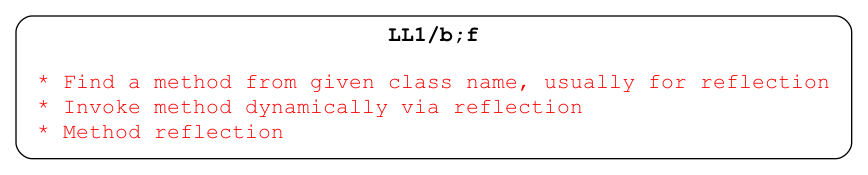
LL1/b;f directly finds methods by class name, invokes them dynamically, and performs method reflection. Combined, these APIs enable runtime method discovery and invocation that evades signature-based static analysis.
Behaviors detected by Quark:
Invoke method dynamically via reflection (#00276)
2. T1407 Download New Code at Runtime
T1407 Download New Code at Runtime — attack.mitre.org
MITRE definition (T1407): Adversaries may download additional code or resources at runtime to update existing capabilities or to install new modules at execution time. Adversaries may use this technique to update legitimate-looking malicious code or to gradually escalate capabilities after initial install.
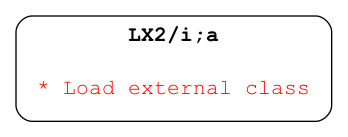
LX2/i;a directly loads an external class via the class loader. This call enables the malware to dynamically load additional code modules at runtime, expanding capabilities beyond what is visible in the on-disk APK.
Behaviors detected by Quark:
Load external class (#00032)
List of Tested APKs
The table below lists the APKs we tested.
index |
sha256 |
|---|---|
1 |
1660B4FE77254FAC07AABAF39A11AE3462A6513CC861C8620B56B8734AA46A90 |
2 |
16F961B4F3F974109AE0DE2546B092138BD29DCC1B8EC12EFC487D34DDEA2BD4 |
3 |
2C6B914F9E27482152F704D3BAEA6C8030DA859C9F5807BE4E615680F93563A0 |
4 |
331DE31F0862980F9609B8F6A1DB7585AC23BEA5676BE4DE6B7F74BCF0DADFCF |
5 |
3FB91010B9B7BFC84CD0C1421DF0C8C3017B5ECF26F2E7DADFE611F2A834330C |
6 |
AA264D6F85A121013D96BF0FE81239C328AE49C5965F49A91CA9049B968B2DB8 |
7 |
BA622A4F0D30C433A1D36DDFF294759582067D5EAE438937DEF75987FAC67B33 |
NGate Malware Family Analysis Report
A new Quark rule (#00277) was generated to detect NFC reader-mode preparation and added to Quark’s rule pool. NGate is an Android NFC banking trojan first documented by ESET in 2024, targeting Slovak banking customers. It is documented to weaponize the open-source NFCGate research toolkit to relay contactless payment card data from the victim’s phone to an attacker-controlled device, enabling unauthorized point-of-sale and ATM transactions. Check here for the rule pool details.
Quark’s rule classification flagged 14 of 14 NGate samples as high-risk in this experiment (detection rate 100%). Benign-cohort false-positive rate was not measured here. Please check here for the APKs we tested.
Identified Well-Known Threats
This section uses MITRE ATT&CK Mobile as its reference taxonomy. NGate has no dedicated MITRE software entry. The techniques below were observed in NGate samples through Quark’s static bytecode analysis.
MITRE Technique |
Real-world manifestation in NGate |
|---|---|
T1644 Out of Band Data |
Configuring the IsoDep NFC reader with a non-default transceive timeout — the canonical preparation step required before APDU exchange over the NFC out-of-band channel, used by NGate as part of its documented contactless-card relay chain |
T1406 Obfuscated Files or Information |
Dynamic method invocation via Java reflection from many attacker-authored classes, hiding the malware’s true control flow from static analysis tools |
T1628.001 Suppress Application Icon |
Programmatically hiding the malicious app’s launcher icon after installation to delay user detection and removal |
All cluster representatives below were extracted from sample 98f2667aec5f74c0701467ea86c6a45a53604075f968263c12650759d157ba59.apk — chosen as the representative sample whose detected behaviors most fully cover the documented profile of NGate. The other 13 family samples were used to compute the detection-rate figure above.
Each section below corresponds to one technique from the table above. Within each section we first quote the MITRE definition, then walk through the call sequence and list the underlying rules.
1. T1644 Out of Band Data
T1644 Out of Band Data — attack.mitre.org
MITRE definition (T1644): Adversaries may communicate with compromised devices using out of band data streams. This could be done for a variety of reasons, including evading network traffic monitoring, as a backup method of command and control, or for data exfiltration if the device is not connected to any Internet-providing networks. Several out of band data streams exist, such as SMS messages, NFC, and Bluetooth.
LK1/d;b (a ProGuard-renamed class operating on Landroid/nfc/Tag, consistent with the NFCGate-derived reader-mode initialization that NGate is documented to repackage) calls IsoDep.get(Tag) to acquire an IsoDep handle for the contactless card and then IsoDep.setTimeout(int) on the same instance, with the IsoDep reference flowing directly between the two calls. Configuring a custom transceive timeout is uncharacteristic of legitimate payment apps (which use the platform default) and is the canonical setup step required before any subsequent APDU exchange over the NFC out-of-band channel.
Behaviors detected by Quark:
Configure custom timeout for IsoDep card communication (NFC reader-mode preparation) (#00277)
2. T1406 Obfuscated Files or Information
T1406 Obfuscated Files or Information — attack.mitre.org
MITRE definition (T1406): Adversaries may attempt to make a payload or file difficult to discover or analyze by encrypting, encoding, or otherwise obfuscating its contents on the device or in transit. This is common behavior that can be used across different platforms and the network to evade defenses.
LO/q;onPrepareActionMode is one of nine distinct attacker-namespace parents in this sample where the malware dynamically resolves a method by name and invokes it via reflection. Spreading reflective dispatch across many short ProGuard-renamed classes obfuscates the actual call targets from static disassembly tools that match on direct call edges, falling under T1406’s broader “otherwise obfuscating its contents” clause for control-flow obfuscation.
Behaviors detected by Quark:
Invoke method dynamically via reflection (#00276)
3. T1628.001 Suppress Application Icon
T1628.001 Suppress Application Icon — attack.mitre.org
MITRE definition (T1628.001): A malicious application could suppress its icon from being displayed to the user in the application launcher. This hides the fact that it is installed, and can make it more difficult for the user to uninstall the application. Hiding the application’s icon programmatically does not require any special permissions.
LZ/h;run (an attacker-authored Runnable executed from background context) toggles the launcher activity’s ComponentEnabledSetting to COMPONENT_ENABLED_STATE_DISABLED, hiding the app’s icon from the device home screen. This delays user discovery of the installed app and makes uninstalling it harder.
Behaviors detected by Quark:
Hide the current app’s icon (#00079)
List of Tested APKs
The table below lists the APKs we tested.
index |
sha256 |
|---|---|
1 |
0E2AEE7B6CF50249520F0F824EA52F7770E2D2A791F0E6D94C514B11ED482FA4 |
2 |
162F8C6BAFE0C343C37F173344C4F6880EAEC0AEA7B491565DB874366B161784 |
3 |
17A16F08108E25AF1C8B058ADBACA2CADA6A93C2D38C9854148F9E9CAAC76AC3 |
4 |
1D126E5904DDE3B46175A4AAE89EEC1FB8A6B80E35B1F473878E5DD288F8AAE6 |
5 |
31FDAA61CADD545C4C859ED255ADA413CBB09B2201F047745A7374EC1D54AA43 |
6 |
3CB4B373A24AFB10B8003762E763E6B44008BDF9A58D0A9A2B80A5DE68308ECD |
7 |
45BBA7681E5A2C3512E6337BAED739D3AF30AF5BFC9FFE0AE18E211E068274A1 |
8 |
54EAC45F3F5AC121C74C2EF66923CD3DA5A5DC8B03BF3E4C43935FCC1E5F6EED |
9 |
5CFE6EC669BE05D457D9B98CDD76901CC8913AE9F4E8B1A29D97770C6925A5C4 |
10 |
9220B2F18DD79BEF1D9B3739D42DA538BFBCC73CDA4F9B0028C2F425BE501FB1 |
11 |
95D906DCA5A3BE5CF066268662B3C953860E54E9CDCFCD427FAF0AAA9CB62BAD |
12 |
98F2667AEC5F74C0701467EA86C6A45A53604075F968263C12650759D157BA59 |
13 |
C659454DD6ED62BC7A0C9E0455297E41BA57B0B7935A826150C1F8C0DB6F89D2 |
14 |
E19A7C8E4994EA4ED680136C9E3A6FFF7B82C72F5743952821A446B6CB830F06 |
AhRat Malware Family Analysis Report
This report analyzes the AhRat malware family using Quark’s rule classification. AhRat is an Android remote access trojan (RAT) derived from the open-source AhMyth project. It was publicly disclosed by ESET in May 2023 inside the “iRecorder — Screen Recorder” application on Google Play (~50,000 installs at the time of takedown), and continues to circulate as repackaged flashlight, screen-recorder, and utility apps in third-party Android stores. This run did not generate a new rule for AhRat: the family’s most distinctive bytecode patterns (microphone audio capture, camera photo capture, SMS reads AND sends, last-known-location lookups) are already covered by Quark’s existing rule set. Check here for the rule set details.
Quark’s rule classification flagged 15 of 15 AhRat samples as high-risk in this experiment (detection rate 100%). Benign-cohort false-positive rate was not measured here. Please check here for the APKs we tested.
Identified Well-Known Threats
This section uses MITRE ATT&CK Mobile as its reference taxonomy, anchored to the S1095 AhRat software entry. Of the 15 techniques documented for the family, Quark’s static bytecode analysis surfaces the 5 listed below; the other 10 rely on runtime or network observation, or are not exercised by the samples in this cohort.
MITRE Technique |
Real-world manifestation in AhRat |
|---|---|
T1429 Audio Capture |
Recording microphone audio via |
T1430 Location Tracking |
Reading the device’s last-known GPS coordinates via |
T1513 Screen Capture |
Decoding a raw JPEG byte buffer into a |
T1533 Data from Local System |
Querying the SMS and call-log content providers with |
T1582 SMS Control |
Dispatching operator-driven SMS actions from a C2 socket — the |
All cluster representatives below were extracted from sample c90bb703a45863aa5e7fdc60a4ad32f933adca82ecddb1c42cf35a17f8078434.apk — chosen as the representative sample whose detected behaviors most fully cover the documented profile of AhRat. The other 14 family samples were used to compute the detection-rate figure above.
Each section below corresponds to one technique from the table above. Within each section we first quote the MITRE definition, then walk through the call sequence and list the underlying rules.
1. T1429 Audio Capture
T1429 Audio Capture — attack.mitre.org
MITRE definition (T1429): Adversaries may capture audio to collect information by leveraging standard operating system APIs of a mobile device. Examples of audio information adversaries may target include user conversations, surroundings, phone calls, or other sensitive information.

Lcom/lahsuak/apps/flashlight/connect/MicManager;startRecording (an attacker-authored helper class bundled inside a repackaged “flashlight” carrier app) initializes a MediaRecorder with the microphone as its audio source and starts recording ambient audio to a file. The captured audio is then read back by the RAT dispatcher for delivery to the operator.
Behaviors detected by Quark:
Initialize the recorder and start recording (#00198)
2. T1430 Location Tracking
T1430 Location Tracking — attack.mitre.org
MITRE definition (T1430): Adversaries may track a device’s physical location through use of standard operating system APIs via malicious or exploited applications on the compromised device. On Android, applications holding the
ACCESS_COARSE_LOCATIONorACCESS_FINE_LOCATIONpermissions provide access to the device’s physical location.

Lcom/lahsuak/apps/flashlight/connect/LocManager;getLocation (an attacker-authored helper class bundled inside a repackaged “flashlight” carrier app) calls LocationManager.getLastKnownLocation and then reads the latitude/longitude off the returned Location instance. The call sequence returns the device’s last-known GPS coordinates to the RAT dispatcher, matching the location-collection surface T1430 describes.
Behaviors detected by Quark:
Get last known location of the device (#00115)
3. T1513 Screen Capture
T1513 Screen Capture — attack.mitre.org
MITRE definition (T1513): Adversaries may use screen capture to collect additional information about a target device, such as applications running in the foreground, user data, credentials, or other sensitive information.

Lcom/lahsuak/apps/flashlight/connect/CameraManager;sendPhoto (an attacker-authored helper class bundled inside a repackaged “flashlight” carrier app) decodes a raw JPEG-byte buffer into an in-memory Bitmap and then compresses that bitmap back out to a JPEG stream for exfiltration by the RAT dispatcher. This decode-then-recompress pattern is how AhRat’s photo-collection helper packages a fresh camera frame into a network-ready payload before shipping it to the operator.
Behaviors detected by Quark:
Initialize bitmap object and compress data (e.g. JPEG) into bitmap object (#00001)
Compress bitmap (#00269)
4. T1533 Data from Local System
T1533 Data from Local System — attack.mitre.org
MITRE definition (T1533): Adversaries may search local system sources, such as file systems or local databases, to find files of interest and sensitive data prior to exfiltration. Access to local system data, which includes information stored by the operating system, often requires escalated privileges.

Lcom/lahsuak/apps/flashlight/connect/SMSManager;getSMSList opens a ContentResolver cursor against the SMS and call-log content URIs, iterates the result set, and copies message body / address / call metadata fields into a JSON object. This is the local-database read step that satisfies the “search local system sources … to find files of interest and sensitive data” clause of T1533; the returned JSON object is the collected artefact.
Behaviors detected by Quark:
Query data from URI (SMS, CALLLOGS) (#00011)
Read sensitive data(SMS, CALLLOG, etc) (#00077)
Get messages in the SMS inbox (#00191)
Query device data with ContentResolver (#00212)
Query device data with ContentResolver and a URI parsed from a string (#00222)
5. T1582 SMS Control
T1582 SMS Control — attack.mitre.org
MITRE definition (T1582): Adversaries may delete, alter, or send SMS messages without user authorization. This could be used to hide C2 SMS messages, spread malware via SMS, or various external effects.
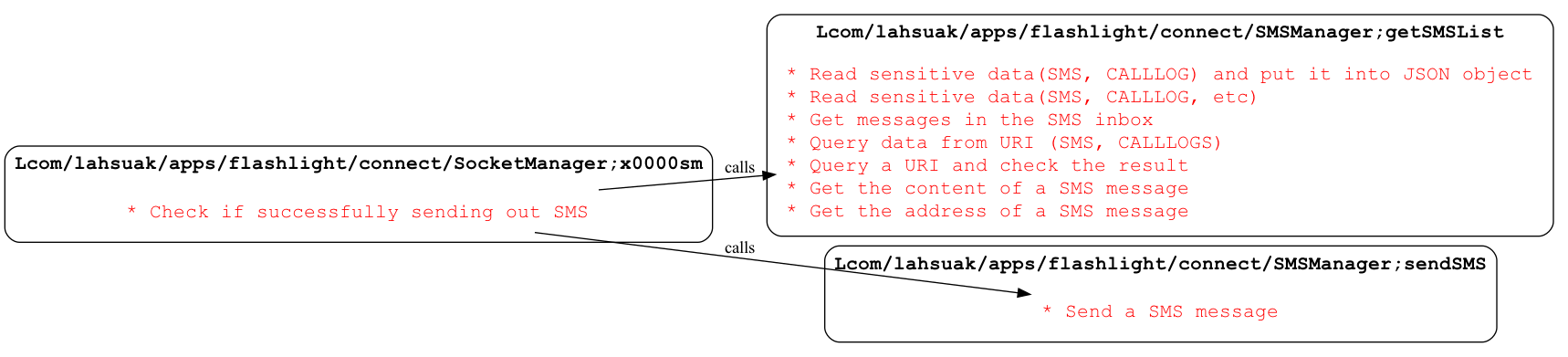
Lcom/lahsuak/apps/flashlight/connect/SocketManager;x0000sm is the C2 message dispatcher: it receives operator commands over the socket and routes each command to a dedicated helper. Two of those helpers — SMSManager;sendSMS and SMSManager;getSMSList — wrap the platform SmsManager.sendTextMessage and the SMS-inbox ContentResolver query respectively. Together they let the remote operator both inject outbound SMS and pull inbox content on demand.
Behaviors detected by Quark:
Check if successfully sending out SMS (#00008)
Send a SMS message (#00193)
Query data from URI (SMS, CALLLOGS) (#00011)
Read sensitive data(SMS, CALLLOG, etc) (#00077)
List of Tested APKs
The table below lists the APKs we tested.
index |
sha256 |
|---|---|
1 |
057689E28C35811575811BEAA1FA07BDC0130188F4590D286A564A0236060048 |
2 |
0C258DE0590AEFC9B66BE08A33015581373E19FE9887355C57D9FEF59153906A |
3 |
0C485D9CBF8AAE82788B863512C750EA0B01A859AC4C7AE2461ED52482C02FED |
4 |
1D000EF8D964BA22ACF820DEBD2C24222FF34353C145D69E4266EB2CC7588BA3 |
5 |
1E1E23C920EEACA8E9FFC1F946FCB978FA2419815B7B5DCF9A1CCA9B934F8C4B |
6 |
2AEC43A86C635CAE0EC5F4BD2E216EBA61DA36B65068A86DA324224627193BCE |
7 |
4D814FDFB79B50F4DA1CDCC3ACA7FBCC4C9C1826CDBDCCE86CFD72906DBE8F8F |
8 |
4D89AFB5E33AE85630D73D0B3D9765F523B9E0B6E1E80E4CE50780EA486B8315 |
9 |
6DE9C4A91A1D17473029AA0C7CA98580779734282CB91BF7AA7B8DD54CD6C6B6 |
10 |
8542C3F7C5AC22933F95529085B73F98F6AE7F1548E9AC1B57A7CF9458500A1D |
11 |
A156A76D2041D01594D791DA97E8EB9179841FE0DFC3C6831F8F413CACC0A3DE |
12 |
BCE898587F683C70EA12B8612DD9DC1F791FA748E7C1F4584F4AFB2009A1E135 |
13 |
BFC577EA1B9B326609D857E0C7EA4C7DB5C382F86B3FAEB92E9230DA650B3AF9 |
14 |
C90BB703A45863AA5E7FDC60A4AD32F933ADCA82ECDDB1C42CF35A17F8078434 |
15 |
CDD0D2E6639BFB11299B168748C77BCED8821075C6CB04ED4B1F888A369228FD |
AndroRAT Malware Family Analysis Report
This report analyzes the AndroRAT malware family using Quark’s rule classification. AndroRAT is one of the earliest open-source Android remote access trojans, originating from a 2012 university project (DesignativeDave/AndroRAT). Its source code has been extensively forked and repackaged over the years — including the DroidJack commercial fork, the karma9874 revival, and various trojanized carrier apps in third-party stores. A new Quark rule (#00278) was generated to detect the video-capture pattern used by the DroidJack fork (MediaRecorder.setVideoSource + setProfile); other distinctive bytecode patterns (microphone audio capture, last-known-location lookups, SMS send + inbox reads, phone-call intents, call-log reads via ContentResolver) are already covered by Quark’s existing rule set. Check here for the rule set details.
Quark’s rule classification flagged 5 of 5 AndroRAT samples as high-risk in this experiment (detection rate 100%). Benign-cohort false-positive rate was not measured here. Please check here for the APKs we tested.
Identified Well-Known Threats
This section uses MITRE ATT&CK Mobile as its reference taxonomy, anchored to the S0292 AndroRAT software entry. Of the 10 techniques documented for the family, Quark’s static bytecode analysis surfaces the 7 listed below; see the coverage-gap notes at the end of this section for why the other 3 are not demonstrated here.
MITRE Technique |
Real-world manifestation in AndroRAT |
|---|---|
T1429 Audio Capture |
Recording ambient microphone audio via |
T1430 Location Tracking |
Reading the device’s last-known GPS coordinates via |
T1582 SMS Control |
Receiving operator commands over the C2 socket and issuing outbound |
T1616 Call Control |
Constructing an |
T1512 Video Capture |
Configuring a |
T1636.002 Call Log |
Querying the call-log |
T1636.004 SMS Messages |
Reading SMS inbox contents (sender address, message body) via |
All cluster representatives below were extracted from either sample 48d25786... (net.droidjack.sandrorat — the DroidJack fork) or sample 9c8d02ff... (my.app.client — the pristine AndroRAT builder default) or sample 347f1b01... (com.example.reverseshell2 — a widely-forked open-source variant). Different techniques picked different samples as their strongest evidence source. The remaining samples were used to compute the detection-rate figure above.
Each section below corresponds to one technique from the table above. Within each section we first quote the MITRE definition, then walk through the call sequence and list the underlying rules.
1. T1429 Audio Capture
T1429 Audio Capture — attack.mitre.org
MITRE definition (T1429): Adversaries may capture audio to collect information by leveraging standard operating system APIs of a mobile device. Examples of audio information adversaries may target include user conversations, surroundings, phone calls, or other sensitive information.

Lnet/droidjack/sandrorat/VideoCap;a (an attacker-authored capture helper in the DroidJack fork) initializes a MediaRecorder with the microphone as its audio source and starts recording ambient audio to a file. The captured audio is then read back by the RAT dispatcher for delivery to the operator.
Behaviors detected by Quark:
Initialize the recorder and start recording (#00198)
2. T1430 Location Tracking
T1430 Location Tracking — attack.mitre.org
MITRE definition (T1430): Adversaries may track a device’s physical location through use of standard operating system APIs via malicious or exploited applications on the compromised device. On Android, applications holding the
ACCESS_COARSE_LOCATIONorACCESS_FINE_LOCATIONpermissions provide access to the device’s physical location.
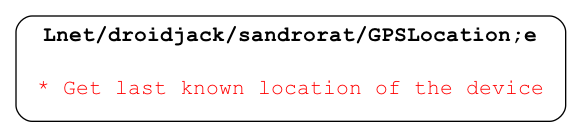
Lnet/droidjack/sandrorat/GPSLocation;e (an attacker-authored location helper in the DroidJack fork) calls LocationManager.getLastKnownLocation and reads the latitude/longitude off the returned Location instance. The call sequence returns the device’s last-known GPS coordinates to the RAT dispatcher.
Behaviors detected by Quark:
Get last known location of the device (#00115)
3. T1582 SMS Control
T1582 SMS Control — attack.mitre.org
MITRE definition (T1582): Adversaries may delete, alter, or send SMS messages without user authorization. This could be used to hide C2 SMS messages, spread malware via SMS, or various external effects.
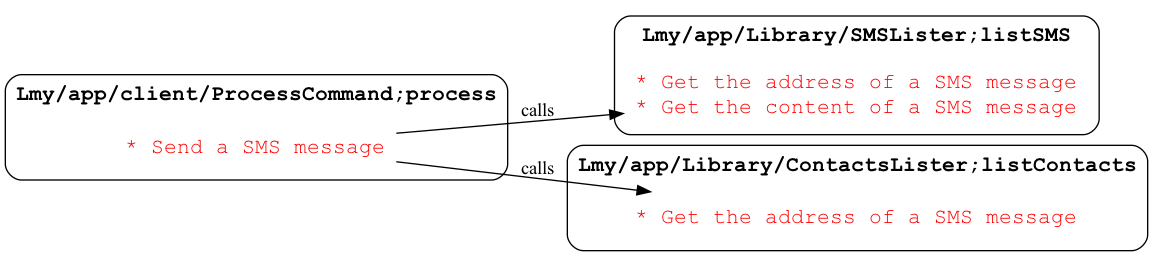
Lmy/app/client/ProcessCommand;process (the C2 command dispatcher in the pristine AndroRAT builder namespace) receives operator commands over the socket and routes each command to a helper. Two of those helpers — the SMS-send branch reaching SmsManager.sendTextMessage and the SMS-read branch reaching SMSLister;listSMS — together let the remote operator both inject outbound SMS and pull inbox content on demand.
Behaviors detected by Quark:
Send a SMS message (#00193)
4. T1616 Call Control
T1616 Call Control — attack.mitre.org
MITRE definition (T1616): Adversaries may make, forward, or block phone calls without user authorization. This could be used for adversary goals such as audio surveillance, blocking or forwarding calls from the device owner, or C2 communication.

Lnet/droidjack/sandrorat/m;a (an attacker-authored call helper in the DroidJack fork) constructs an Intent with the ACTION_CALL action, packs an operator-supplied phone number into the intent’s URI via setData, and invokes startActivity — placing an outbound phone call without user consent.
Behaviors detected by Quark:
Put a phone number into an intent (#00203)
Make a phone call (#00202)
Implicit intent(view a web page, make a phone call, etc.) via setData (#00051)
5. T1512 Video Capture
T1512 Video Capture — attack.mitre.org
MITRE definition (T1512): An adversary can leverage a device’s cameras to gather information by capturing video recordings. Images may also be captured, potentially in specified intervals, in lieu of video files.

Lnet/droidjack/sandrorat/VideoCap;a (an attacker-authored capture helper in the DroidJack fork) calls MediaRecorder.setVideoSource to select the device camera as the recording input, then MediaRecorder.setProfile to apply a camcorder recording profile in preparation for exfiltrating the captured video to the RAT dispatcher. Rule #00278 was added in this run to cover this pair.
Behaviors detected by Quark:
Configure video source and camcorder profile for video capture recording (#00278)
6. T1636.002 Call Log
T1636.002 Call Log — attack.mitre.org
MITRE definition (T1636.002): Adversaries may utilize standard operating system APIs to gather call log data. On Android, this can be accomplished using the Call Log Content Provider.
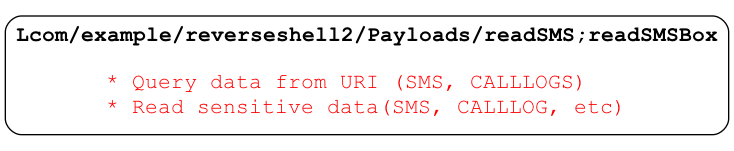
Lcom/example/reverseshell2/Payloads/readSMS;readSMSBox (an attacker-authored payload class in the reverseshell2 open-source variant — despite the SMS-suggestive name, the method queries both the SMS and call-log content-provider URIs) opens a ContentResolver cursor against those URIs and copies the returned rows into an exfiltration buffer.
Behaviors detected by Quark:
Query data from URI (SMS, CALLLOGS) (#00011)
Read sensitive data(SMS, CALLLOG, etc) (#00077)
7. T1636.004 SMS Messages
T1636.004 SMS Messages — attack.mitre.org
MITRE definition (T1636.004): Adversaries may utilize standard operating system APIs to gather SMS messages. On Android, this can be accomplished using the SMS Content Provider.

Lnet/droidjack/sandrorat/bd;b (an attacker-authored SMS reader in the DroidJack fork) opens a ContentResolver cursor against the SMS content URI, iterates the result set, and extracts sender address, inbox row IDs, and message body strings for exfiltration.
Behaviors detected by Quark:
Get messages in the SMS inbox (#00191)
Get the address of a SMS message (#00188)
Get the content of a SMS message (#00189)
Coverage-gap notes
The 3 MITRE techniques documented for AndroRAT that this report does NOT demonstrate:
T1422 System Network Configuration Discovery — the samples do read SIM operator and SIM state, but the reads are single-API calls (
TelephonyManager.getSimOperator,getSimState) whose bytecode is indistinguishable from what carrier, dual-SIM, roaming-detector, and MFA apps do for legitimate reasons. Quark’s rule format requires two APIs linked by data flow, so this single-API dual-use surface cannot be expressed as a stand-alone rule without a companion API that isolates the malware use case — a rule of that shape does not currently exist in the pool.T1636.003 Contact List — reading the contacts content provider is likewise a single-step call (
ContentResolver.query(Contacts.CONTENT_URI)) that every messenger, dialer, and address-book app performs. This hits the same Quark architectural limit as T1422: no discriminative two-API pattern is available.T1655.001 Match Legitimate Name or Location — this is a runtime impersonation technique (app icon / name / package-name similarity to a real app) requiring cross-app comparison at install time; it is out of scope for static bytecode analysis.
List of Tested APKs
The table below lists the APKs we tested.
index |
sha256 |
|---|---|
1 |
347F1B018F643DE0B9C946C94BD490A7426503869A0828B0A70B4D318FA097D6 |
2 |
48D25786B7512761ED561BB50DE4C0BD8A19DF0E5DE2BC40CD9D84DDDF11C16D |
3 |
9C8D02FF190F5929BC6745A541C326B2CD387D3145C759823D24972E65398A99 |
4 |
C5AB0ADAEDF391A395387DF33B0BF6854F1CCC9C5DA937915EA86B5EEC6E6103 |
5 |
D62705186C488BB26FCCDB1404931223A887004FD6704AC1483E599A15E92792 |
Sova Malware Family Analysis Report
This report analyses the Sova malware family using Quark’s rule classification. Sova is an Android banking trojan first surfaced in mid-2021, distributed as trojanised carrier apps (fake BurgerKing, cryptocurrency wallets, delivery apps) that abuse Accessibility services to overlay banking / crypto exchange UIs, harvest credentials, intercept SMS one-time passwords, and — in the v5 branch — encrypt on-device files as ransomware. This run did not generate a new rule for Sova: the family’s distinctive bytecode patterns (device-fingerprint queries and outbound-call intents from a single C2-message dispatcher) are already covered by Quark’s existing rule set. Check here for the rule set details.
Quark’s rule classification flagged 14 of 14 Sova samples as high-risk in this experiment (detection rate 100%). Benign-cohort false-positive rate was not measured here. Please check here for the APKs we tested.
Identified Well-Known Threats
This section uses MITRE ATT&CK Mobile as its reference taxonomy, anchored to the S1062 S.O.V.A. software entry. Of the 19 techniques documented for the family, Quark’s static bytecode analysis surfaces the 3 listed below; see the coverage-gap notes at the end of this section for why the other 16 are not demonstrated here.
MITRE Technique |
Real-world manifestation in Sova |
|---|---|
T1426 System Information Discovery |
Reading device phone number and IMEI inside the C2 ping-response handler for victim profiling |
T1582 SMS Control |
Dispatching SMS-send operations from a helper ( |
T1616 Call Control |
Constructing an |
All cluster representatives below were extracted from sample 724a56172f40177da76242ee169ac336b63d5df85889368d1531f593b658606b.apk (a fake BurgerKing carrier — package com.tapston.burgerking), chosen as the representative sample whose detected behaviors most fully cover the documented profile of Sova. The other 13 family samples were used to compute the detection-rate figure above.
Each section below corresponds to one technique from the table above. Within each section we first quote the MITRE definition, then walk through the call sequence and list the underlying rules.
1. T1426 System Information Discovery
T1426 System Information Discovery — attack.mitre.org
MITRE definition (T1426): Adversaries may attempt to get detailed information about a device’s operating system and hardware, including versions, patches, and architecture.

Lcom/tapston/burgerking/service/worker/PingTasks;onPingReceived (an attacker-authored C2 ping-response handler inside the fake BurgerKing carrier app) is invoked whenever the operator’s ping message arrives on the dispatcher; within this method the malware calls TelephonyManager.getLine1Number and getDeviceId to read the victim’s phone number and IMEI, then ships them back over the C2 socket as part of the ping ACK payload.
Behaviors detected by Quark:
Query the IMEI number (#00033)
Query the phone number (#00038)
2. T1582 SMS Control
T1582 SMS Control — attack.mitre.org
MITRE definition (T1582): Adversaries may delete, alter, or send SMS messages without user authorization. This could be used to hide C2 SMS messages, spread malware via SMS, or various external effects.

The same Lcom/tapston/burgerking/service/worker/PingTasks;onPingReceived handler routes a subset of operator commands to an attacker-authored Kotlin extension helper Lcom/tapston/burgerking/extensions/context/ContexStartExtensionsKt;sendSMS, which wraps SmsManager.sendTextMessage to inject outbound SMS on behalf of the operator. The dispatcher also references a content-URI delete primitive on the SMS/call-log providers to remove traces after sending.
Behaviors detected by Quark:
Send a SMS message (#00193)
Deletes media specified by a content URI (SMS, CALL_LOG, File, etc.) (#00201)
3. T1616 Call Control
T1616 Call Control — attack.mitre.org
MITRE definition (T1616): Adversaries may make, forward, or block phone calls without user authorization. This could be used for adversary goals such as audio surveillance, blocking or forwarding calls from the device owner, or C2 communication.

The same Lcom/tapston/burgerking/service/worker/PingTasks;onPingReceived handler also handles the “place-call” operator command: it constructs an Intent with the ACTION_CALL action, packs an operator-supplied phone number into the intent’s URI via setData, and invokes startActivity — placing an outbound phone call without user consent.
Behaviors detected by Quark:
Put a phone number into an intent (#00203)
Make a phone call (#00202)
Implicit intent(view a web page, make a phone call, etc.) via setData (#00051)
Coverage-gap notes
The 16 MITRE techniques documented for Sova that this report does NOT demonstrate, grouped by the reason Quark could not confirm them on these samples:
The two APIs share a caller, but it sits deeper than Quark searches (7) — While the techniques below are triggered by Sova’s service dispatcher, the actual APIs are hidden in helper functions more than 3 layers deep. For performance reasons, Quark does not search beyond 3 layers by default. As a result, these techniques are currently not detected by Quark, but we are actively working on addressing this limitation.
Technique |
First API |
Second API |
Nearest shared caller |
|---|---|---|---|
T1516 Input Injection |
|
|
|
T1417.001 Keylogging |
|
|
|
T1417.002 GUI Input Capture |
|
|
activity / service lifecycle callbacks |
T1517 Access Notifications |
|
|
|
T1628.001 Suppress Application Icon |
|
|
reached only inside bundled libraries (AndroidX WorkManager, Xiaomi push, Taobao SDK) |
T1629.001 Prevent Application Removal |
|
|
device-admin setup flow |
T1630.001 Uninstall Malicious Application |
|
|
n/a — the pair is too generic to rule on, since every launcher and settings screen uses it |
Runtime / network-only behavior (3) — bytecode analysis cannot capture these because the malicious intent lives in runtime C2 messages, not in distinct API pairs.
T1464 Network Denial of Service — DDoS traffic is issued via generic
Socket.connect/HttpURLConnection, indistinguishable in bytecode from a legitimate app.T1437.001 Web Protocols — C2 uses OkHttp / HttpURLConnection with runtime-supplied URLs.
T1638 Adversary-in-the-Middle — requires runtime network observation.
Sample cohort does not exercise the behavior (3)
T1471 Data Encrypted for Impact — Sova v5’s ransomware module encrypts device files with a runtime-delivered AES key. The samples in this cohort are pre-v5 banking builds and do not carry the encryption module.
T1641.001 Transmitted Data Manipulation (clipboard) — ThreatFabric documents clipboard hijacking (crypto-address swap) in Sova v5+; the
ClipboardManagerreferences in this cohort all fire inside bundled utility libraries (WhatsApp clones, React Native / Flutter clipboard modules) rather than in attacker code, so the Sova-authored clipboard-swap logic is not present in these samples.T1406.002 Software Packing — a distribution characteristic (how the APK is shipped), not a bytecode behavior visible after unpacking.
Behavior confirmed by Quark but attributed to bundled library (2)
T1418 Software Discovery —
PackageManager.getInstalledApplicationsandgetPackageInfofire in Sova’s samples but always inside the Getui push SDK (Lcom/igexin/push/…), which uses the same API to build push-targeting maps. Sova likely reuses the SDK’s cache rather than calling the primitive itself.T1513 Screen Capture — canvas / bitmap-compress pair fires only inside
Lcom/horcrux/svg/SvgView(react-native-svg rendering), not attacker code. Sova’s actual screen capture usesAccessibilityService.takeScreenshot, a single-API surface with the same limitation as the group above.
Runtime impersonation (1)
T1655.001 Match Legitimate Name or Location — impersonating a real app by icon / name / package similarity (e.g. Sova samples disguising as BurgerKing) requires cross-app comparison at install time; out of scope for static bytecode analysis of a single APK.
List of Tested APKs
The table below lists the APKs we tested.
index |
sha256 |
|---|---|
1 |
15EAE9134DAC9268CBF005C23299C88DD5C5176A240201DA751691A543375360 |
2 |
1981394E719BDFD9E29D57386D8CA05CEECC2DDD31F658255C068D6963DF17C1 |
3 |
2124777F710199D4051C9D67185DC4DBB55252D65B57642222EEE444C5C06D88 |
4 |
376D13AFFCBFC5D5358D39ABA16B814F711F2E81632059A4BCE5AF060E038EA4 |
5 |
3EB7EFA71648AE819F1BFF89399717805129487081E8261DD65BF596F2467054 |
6 |
6F7E57ED7239905FAFC3947160B5FC89AD615772D2A694299999D2FE080453F4 |
7 |
724A56172F40177DA76242EE169AC336B63D5DF85889368D1531F593B658606B |
8 |
795B279F312A773F7F556A978387F1B682F93470DB4C1B5F9CD6CA2CAB1399B6 |
9 |
7C805F51EE3B2994E742D73954E51D7C2C24C76455B0B9A1B44D61CB4E280502 |
10 |
B01B74AAF249D0740F541C081C0C0DE4BF455B4B68F2634FAB6CF8AAFCD95D52 |
11 |
BBAF483C2B6F67F22EB6E1FA00F200E9C1E201B0110070ACAEFD416CF846B1AA |
12 |
EC5B083C017570F846F6925B7C79D9E5886525A9B7BA7E514DABAD0325C0AF5E |
13 |
EFB92FB17348EB10BA3A93AB004422C30BCF8AE72F302872E9EF3263C47133A7 |
14 |
F3FC80A8793E60A901DA44B9AB315931699E64A4F3EDDB8ABA839FE860DE46DC |
EventBot Malware Family Analysis Report
This report analyses the EventBot malware family using Quark’s rule classification. EventBot is an Android banking trojan and information stealer, first documented by Cybereason in March 2020, that abuses Android’s accessibility service to harvest data from more than 200 banking, money-transfer and cryptocurrency-wallet applications, and reads incoming SMS to defeat two-factor authentication. This run did not generate a new rule for EventBot: the family’s distinctive bytecode patterns (installed-app enumeration, SMS broadcast interception, and SMS-body exfiltration over HTTP) are already covered by Quark’s existing rule set. Check here for the rule set details.
Quark’s rule classification flagged 3 of 3 EventBot samples as high-risk in this experiment (detection rate 100%). Benign-cohort false-positive rate was not measured here. Please check here for the APKs we tested.
Identified Well-Known Threats
This section uses MITRE ATT&CK Mobile as its reference taxonomy, anchored to the S0478 EventBot software entry. Of the 14 techniques documented for the family, Quark’s static bytecode analysis surfaces the 3 listed below; see the coverage-gap notes at the end of this section for why the other 11 are not demonstrated here.
MITRE Technique |
Real-world manifestation in EventBot |
|---|---|
T1418 Software Discovery |
Enumerating installed applications and persisting the inventory to shared preferences, so the operator can pick which banking apps to target |
T1624.001 Broadcast Receivers |
Registering an SMS broadcast receiver that fires on every incoming message and hands the intent to a parser |
T1636.004 SMS Messages |
Reading the SMS body out of the received intent and shipping it to the C2 over HTTP, defeating SMS-based two-factor authentication |
All cluster representatives below were extracted from sample 05782e267bd62de78a3db22b1a83ddd3c72cbef95f5a5bc9defdd42a4f5786ec.apk, chosen as the representative sample whose detected behaviors most fully cover the documented profile of EventBot. The other 2 family samples were used to compute the detection-rate figure above.
Each section below corresponds to one technique from the table above. Within each section we first quote the MITRE definition, then walk through the call sequence and list the underlying rules.
1. T1418 Software Discovery
T1418 Software Discovery — attack.mitre.org
MITRE definition (T1418): Adversaries may attempt to get a listing of applications that are installed on a device.

Lcom/example/eventbot/func;regOnWeb — the routine that registers the freshly infected device with the operator’s web panel — calls the helper Lcom/example/eventbot/func;getAllApps, which enumerates every installed application and writes the resulting list into shared preferences. The inventory is then included in the registration payload, letting the operator decide which of EventBot’s 200-plus targeted banking apps are worth attacking on this device.
Behaviors detected by Quark:
Get installed applications and put the list in shared preferences (#00170)
Enumerate installed applications (#00264)
2. T1624.001 Broadcast Receivers
T1624.001 Broadcast Receivers — attack.mitre.org
MITRE definition (T1624.001): Adversaries may establish persistence using system mechanisms that trigger execution based on specific events. Mobile operating systems have means to subscribe to events such as receiving an SMS message, device boot completion, or other device activities.

This section covers the trigger mechanism. Lcom/example/eventbot/func;doSMS is the broadcast-receiver entry point: it inspects the incoming intent’s action to confirm an SMS-received broadcast, then dispatches to Lcom/example/eventbot/func;parseSMS. Because the receiver is bound to a system event rather than to app lifecycle, it runs whenever a message arrives, giving EventBot execution without the user opening the app.
Behaviors detected by Quark:
Monitor the general action to be performed (#00025)
Monitor incoming SMS message (#00234)
Read SMS message from Intents (#00260)
3. T1636.004 SMS Messages
T1636.004 SMS Messages — attack.mitre.org
MITRE definition (T1636.004): Adversaries may utilize standard operating system APIs to gather SMS messages. On Android, this can be accomplished using the SMS Content Provider. iOS provides no standard API to access SMS messages.

This section covers what the receiver collects, once triggered by the mechanism in the previous section. Lcom/example/eventbot/func;parseSMS extracts the message body from the intent and passes it to EventBot’s HTTP sender, which posts it to the C2. This is the step that defeats SMS-based two-factor authentication: one-time codes are read and exfiltrated before or alongside the victim seeing them.
Behaviors detected by Quark:
Monitor the general action to be performed (#00025)
Get SMS message body and send it through http (#00165)
Monitor incoming SMS message (#00234)
Read SMS message from Intents (#00260)
Coverage-gap notes
The 11 MITRE techniques documented for EventBot that this report does NOT demonstrate, grouped by the reason Quark could not confirm them on these samples:
The rule’s two APIs are both present, but no single method calls both (4) — Quark confirms a rule only when one method reaches both of its APIs, so it can trace the value from the first call into the second. For each technique below a rule exists and its APIs are present in the samples (Quark’s stage 2 passes), but EventBot splits the work across separate small helpers, so stage 3 never finds a method holding both.
Technique |
Rule that partially matched |
Where it stopped |
|---|---|---|
T1426 System Information Discovery |
#00033 Query the IMEI number, #00038 Query the phone number |
Both APIs present; no shared calling method |
T1422 System Network Configuration Discovery |
#00059 Query the SIM card status |
Both APIs present; no shared calling method |
T1422.001 Internet Connection Discovery |
#00034 Query the current data network type |
Both APIs present; no shared calling method |
T1513 Screen Capture |
screen-capture rules, matched in all three samples |
Rules fired, but no method held enough of the chain to anchor a call sequence |
Behavior confirmed, but every candidate representative sat in bundled library code (2) — the evidence exists and passed validation, but the methods holding it belong to third-party code, so attributing the behavior to EventBot would be wrong.
Technique |
What was found |
Why it was dropped |
|---|---|---|
T1407 Download New Code at Runtime |
Dynamic class loading plus method reflection, in the obfuscated sample |
That sample’s class names are ProGuard-minified, so its parents cannot be separated from shaded library code |
T1437.001 Web Protocols |
HTTP POST carrying the SMS body and sender address |
The representative parent landed in the bundled HTTP stack. The underlying evidence still appears in this report — rule #00165 is cited under T1636.004 above |
No rule in the current pool targets the technique (2)
T1521.001 Symmetric Cryptography and T1406 Obfuscated Files or Information — the rule pool currently contains no rule describing symmetric-encryption or payload-obfuscation behavior, so neither technique was exercised at all.
The samples do not exhibit the behavior (3) — these are honest non-detections rather than tooling limits. Cybereason documented EventBot as still under active development when discovered, and the capabilities below are absent from the builds in this cohort.
Technique |
What the samples actually do |
What the technique requires |
|---|---|---|
T1417.001 Keylogging |
Accessibility UI inspection — |
An input-capture primitive; reading the view tree is not the same as recording keystrokes |
T1417.002 GUI Input Capture |
Passive dimension queries (navigation-bar and status-bar heights) |
An overlay window or input interception |
T1655.001 Match Legitimate Name or Location |
Hiding the launcher icon |
Evidence of impersonating a specific legitimate app by name, icon or package; icon hiding alone is generic |
List of Tested APKs
The table below lists the APKs we tested.
index |
sha256 |
|---|---|
1 |
05782E267BD62DE78A3DB22B1A83DDD3C72CBEF95F5A5BC9DEFDD42A4F5786EC |
2 |
1A8C17AD1A790554278B055BDB946D4597BA9AF6BE3611EE6311B90C7F7848C5 |
3 |
E6E736DF1923C47F6624DAB18BF6A341995B5E756395256AA0B3F4C43594481A |
Skygofree Malware Family Analysis Report
This report analyses Skygofree malware family using Quark’s rule classification. Skygofree is a multi-stage Android surveillance implant documented by Kaspersky in 2018 and attributed to an Italian IT company selling offensive software. It is delivered through fake mobile-operator pages and, once installed, records audio and video on command, steals files from messaging applications, and downloads further modules from its command and control server. This run did not generate a new rule for Skygofree: the family’s surveillance primitives are already covered by Quark’s existing rule set. Check here for the rule set details.
Quark’s rule classification flagged 2 of 2 Skygofree samples as high-risk in this experiment (detection rate 100%). Benign-cohort false-positive rate was not measured here. Please check here for the APKs we tested.
Identified Well-Known Threats
The behaviours below are referenced from MITRE ATT&CK® Mobile — S0327 Skygofree.
This section uses MITRE ATT&CK Mobile as its reference taxonomy, anchored to the S0327 Skygofree software entry. Of the 8 techniques documented for the family, Quark’s static bytecode analysis surfaces the 4 listed below; see the coverage-gap notes at the end of this section for why the other 4 are not demonstrated here.
MITRE Technique |
Real-world manifestation |
|---|---|
T1429 Audio Capture |
Recording ambient audio and phone calls when device enters specific locations |
T1409 Stored Application Data |
Stealing message databases and files belonging to other installed applications |
T1407 Download New Code at Runtime |
Fetching additional surveillance modules from command and control infrastructure on demand |
T1512 Video Capture |
Recording video through device cameras triggered by attacker commands or conditions |
All behavior maps below were rendered from sample e6aba7629608a525b020f4e76e4694d6d478dd9561d934813004b6903d66e44c.apk (package com.sysmanager) — chosen as the representative sample whose detected behaviors most fully cover the documented profile of Skygofree. The other family sample was used to compute the detection-rate figure above.
Each section below corresponds to one technique from the table above. Within each section we first quote the MITRE definition, then show the Quark behavior map extracted from the representative sample’s bytecode, then walk through the call sequence and list the underlying rules.
1. T1429 Audio Capture
T1429 Audio Capture — attack.mitre.org
MITRE definition (T1429): Adversaries may capture audio to collect information by leveraging standard operating system APIs of a mobile device. Examples of audio information adversaries may target include user conversations, surroundings, phone calls, or other sensitive information.

startRecording directly initializes the recorder and starts recording audio. This call enables the service to capture ambient sound from the device microphone.
Behaviors detected by Quark:
Initialize the recorder and start recording (#00198)
2. T1409 Stored Application Data
T1409 Stored Application Data — attack.mitre.org
MITRE definition (T1409): Adversaries may try to access and collect application data resident on the device.

run calls one helper to read files into streams, retrieve absolute paths, and package file data into JSON objects. Together, these calls enable the malware to access application data files and prepare them for upload.
Behaviors detected by Quark:
Read file and put it into a stream (#00013)
Read file into a stream and put it into a JSON object (#00014)
Get absolute path of the file and store in string (#00020)
Open a file from given absolute path of the file (#00022)
3. T1407 Download New Code at Runtime
T1407 Download New Code at Runtime — attack.mitre.org
MITRE definition (T1407): Adversaries may download and execute dynamic code not included in the original application package after installation. This technique is primarily used to evade static analysis checks and pre-publication scans in official app stores.

doInBackground calls one helper to write HTTP input streams to disk and install APKs from those files. Together, these calls enable the malware to download and install additional applications at runtime.
Behaviors detected by Quark:
Install other APKs from file (#00054)
Write HTTP input stream into a file (#00072)
4. T1512 Video Capture
T1512 Video Capture — attack.mitre.org
MITRE definition (T1512): An adversary can leverage a device’s cameras to gather information by capturing video recordings. Images may also be captured, potentially in specified intervals, in lieu of video files. Malware or scripts may interact with the device cameras through an available API provided by the operating system.
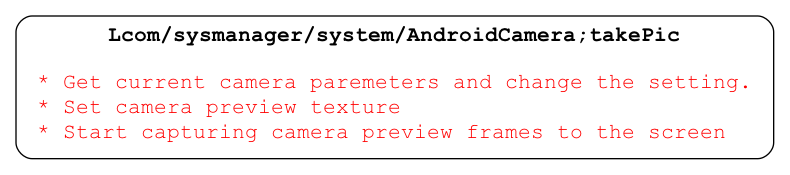
takePic directly configures camera parameters, sets the preview texture, and starts capturing preview frames to the screen. Together, these calls enable the malware to activate the camera and capture visual data.
Behaviors detected by Quark:
Get current camera paremeters and change the setting. (#00183)
Set camera preview texture (#00184)
Start capturing camera preview frames to the screen (#00185)
Coverage-gap notes
The 4 MITRE techniques documented for Skygofree that this report does NOT demonstrate, grouped by the reason Quark could not confirm them on these samples:
The evidence Quark collected does not demonstrate the technique (2) — T1404 Exploitation for Privilege Escalation and T1644 Out of Band Data.
For T1404, sample af848999… downloads a program from its server and runs it through a shell to gain root, in Lcore/syncsystem/methods/Priv$2;run. Quark does reach that code and fires “Executes the specified string Linux command”, because Runtime.exec is an API it can match. The shell command itself, though, is assembled at runtime and handed to exec as a string argument — Runtime.exec(["/system/bin/sh", "-c", <command>]) — and Quark’s rules match API calls, not the strings passed to them. Quark therefore sees that a command ran but never which one, so running an exploit and listing a directory look identical to it.
For T1644, Quark did cluster SMS handling in Lcom/sysmanager/system/SmsReceiver;onReceive, but that cluster reads and filters incoming messages. T1644 requires receiving command and control instructions over binary SMS, which the collected primitives do not show.
Both APIs are present, but no single method passes data between them (1) — T1430 Location Tracking. Quark’s rules for this technique pair Location.getLatitude with Location.getLongitude. Both APIs exist in the samples and Quark reaches stage 3, but no method calls both and passes a value from one to the other, so the match stops short of the data-flow stage that a confirmed detection requires.
The behavior is real but not separable from a technique already shown (1) — T1437.001 Web Protocols. Skygofree’s HTTP command and control traffic is genuine, and Quark confirms it inside Lcom/sysmanager/network/ classes such as GetCommands and StartReverse. The primitives collected there — open a URL, set a request method, read the response stream — are the generic transport that T1407’s download step already rests on, rather than evidence specific to command and control signalling, so no separate cluster was attributed to this technique.
List of Tested APKs
The table below lists the APKs we tested.
index |
sha256 |
|---|---|
1 |
AF848999A4B8DF0E33F5A05A618C83D1F3052D4026AB77B2ACF66DEF71DF754E |
2 |
E6ABA7629608A525B020F4E76E4694D6D478DD9561D934813004B6903D66E44C |
Chrysaor Malware Family Analysis Report
This report analyses the Chrysaor malware family using Quark’s rule classification. Chrysaor is the Android build of the Pegasus spyware developed by NSO Group, documented by Lookout and Google in 2017. It is delivered as a targeted implant that records audio, reads stored messages, and can remove its own traces on command. This run did not add a new rule for Chrysaor. Check here for the rule set details.
Quark’s rule classification flagged 2 of 2 Chrysaor samples as high-risk in this experiment (detection rate 100%). Benign-cohort false-positive rate was not measured here. Please check here for the APKs we tested.
Identified Well-Known Threats
The behaviours below are referenced from MITRE ATT&CK® Mobile — S0316 Pegasus for Android.
This section uses MITRE ATT&CK Mobile as its reference taxonomy, anchored to the S0316 Pegasus for Android software entry — Chrysaor is MITRE’s alias for the same implant. Of the 14 techniques documented for the family, Quark’s static bytecode analysis confirms the 2 listed below; see the coverage-gap notes at the end of this section for why the other 12 are not demonstrated here.
MITRE Technique |
Real-world manifestation |
|---|---|
T1429 Audio Capture |
Recording ambient audio and phone calls for surveillance and intelligence gathering |
T1422.001 Internet Connection Discovery |
Checking whether the device currently has an active network connection |
All behavior maps below were rendered from sample ade8bef0ac29fa363fc9afd958af0074478aef650adeb0318517b48bd996d5d5.apk (package com.network.android) — chosen as the representative sample whose detected behaviors most fully cover the documented profile of Chrysaor. The other family sample was used to compute the detection-rate figure above.
Each section below corresponds to one technique from the table above. Within each section we first quote the MITRE definition, then show the Quark behavior map extracted from the representative sample’s bytecode, then walk through the call sequence and list the underlying rules.
1. T1429 Audio Capture
T1429 Audio Capture — attack.mitre.org
MITRE definition (T1429): Adversaries may capture audio to collect information by leveraging standard operating system APIs of a mobile device. Examples of audio information adversaries may target include user conversations, surroundings, phone calls, or other sensitive information.

Lcom/network/android/roomTap/AutoAnswerReceiver;c directly initializes the recorder and starts recording. This call enables the receiver to capture ambient audio without user interaction.
Behaviors detected by Quark:
Initialize the recorder and start recording (#00198)
2. T1422.001 Internet Connection Discovery
T1422.001 Internet Connection Discovery — attack.mitre.org
MITRE definition (T1422.001): Adversaries may check for Internet connectivity on compromised systems.

Lcom/network/f/a;a directly checks for network connectivity. This call enables the malware to determine whether an active network connection is available.
Behaviors detected by Quark:
Check for network connectivity (#00224)
Coverage-gap notes
The 12 MITRE techniques documented for Chrysaor that this report does NOT demonstrate, grouped by the reason Quark could not confirm them:
What makes it malicious is in the text, not the call (2) — T1404 Exploitation for Privilege Escalation and T1636.002 Call Log. Lcom/network/android/m runs shell commands and Quark sees the call, but a shell call looks the same whatever it runs. T1636.002 fails the same way: the rules that fired cover the SMS and call-log providers together, because both are reached through one API with a different URI string.
The samples do not exhibit the behaviour (7) — T1409 Stored Application Data, T1418 Software Discovery, T1422 System Network Configuration Discovery, T1422.002 Wi-Fi Discovery, T1636.001 Calendar Entries, T1644 Out of Band Data and T1645 Compromise Client Software Binary. These samples do not carry these behaviours, so there is nothing for Quark to detect.
The two calls happen but nothing is passed between them (3) — T1512 Video Capture, T1624.001 Broadcast Receivers and T1636.003 Contact List. Each reaches stage 4: one method makes both calls, in the right order. The camera object, for one, travels through wrapper methods instead of going straight from the first call to the second, so Quark cannot link them.
List of Tested APKs
The table below lists the APKs we tested.
index |
sha256 |
|---|---|
1 |
ADE8BEF0AC29FA363FC9AFD958AF0074478AEF650ADEB0318517B48BD996D5D5 |
2 |
BD8CDA80AAEE3E4A17E9967A1C062AC5C8E4AEFD7EAA3362F54044C2C94DB52A |
Dendroid Malware Family Analysis Report
This report analyses the Dendroid malware family using Quark’s rule classification. Dendroid is a commercial Android RAT sold on underground forums from 2014, whose source code later leaked and seeded a number of derivatives. It is operated through a web panel and disguises itself as a parental-control application. This run did not add a new rule for Dendroid. Check here for the rule set details.
Quark’s rule classification flagged 2 of 2 Dendroid samples as high-risk in this experiment (detection rate 100%). Benign-cohort false-positive rate was not measured here. Please check here for the APKs we tested.
Identified Well-Known Threats
The behaviours below are referenced from MITRE ATT&CK® Mobile — S0301 Dendroid.
This section uses MITRE ATT&CK Mobile as its reference taxonomy, anchored to the S0301 Dendroid software entry. Of the 8 techniques documented for the family, Quark’s static bytecode analysis confirms the 3 listed below; see the coverage-gap notes at the end of this section for the other 5.
MITRE Technique |
Real-world manifestation |
|---|---|
T1429 Audio Capture |
Recording ambient audio or phone calls via microphone access for surveillance |
T1533 Data from Local System |
Reading stored communication records — sent messages and call logs — from the device’s own providers |
T1636.004 SMS Messages |
Harvesting SMS message content including authentication codes and personal communications |
All behavior maps below were rendered from sample 099a57328de9335c524f44514e225d50731c808145221affdd684d8b4dad5a1d.apk (package com.parental.control.v4) — chosen as the representative sample whose detected behaviors most fully cover the documented profile of Dendroid. The other family sample was used to compute the detection-rate figure above.
Each section below corresponds to one technique from the table above. Within each section we first quote the MITRE definition, then show the Quark behavior map extracted from the representative sample’s bytecode, then walk through the call sequence and list the underlying rules.
1. T1429 Audio Capture
T1429 Audio Capture — attack.mitre.org
MITRE definition (T1429): Adversaries may capture audio to collect information by leveraging standard operating system APIs of a mobile device. Examples of audio information adversaries may target include user conversations, surroundings, phone calls, or other sensitive information.
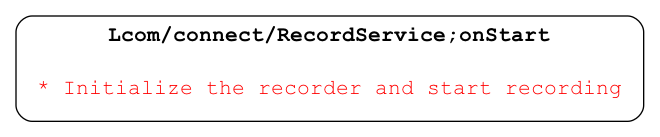
RecordService;onStart directly invokes the MediaRecorder API to initialize the recorder and begin capturing audio. This call enables the service to record ambient sound without user interaction.
Behaviors detected by Quark:
Initialize the recorder and start recording (#00198)
2. T1533 Data From Local System
T1533 Data from Local System — attack.mitre.org
MITRE definition (T1533): Adversaries may search local system sources, such as file systems or local databases, to find files of interest and sensitive data prior to exfiltration. Access to local system data, which includes information stored by the operating system, often requires escalated privileges.

MyService$getSentSms;doInBackground queries content providers through ContentResolver, including the SMS and call-log URIs, and pulls out message bodies and addresses. This task reads the messages the device has sent; the inbox side is covered separately under T1636.004 below.
Behaviors detected by Quark:
Query data from URI (SMS, CALLLOGS) (#00011)
Read sensitive data(SMS, CALLLOG, etc) (#00077)
Query a URI and check the result (#00187)
Get the address of a SMS message (#00188)
Get the content of a SMS message (#00189)
Query a URI and append the result into a string (#00190)
Query device data with ContentResolver (#00212)
Query device data with ContentResolver and a URI parsed from a string (#00222)
Accessing sensitive data from content provider (#00271)
3. T1636.004 SMS Messages
T1636.004 SMS Messages — attack.mitre.org
MITRE definition (T1636.004): Adversaries may utilize standard operating system APIs to gather SMS messages. On Android, this can be accomplished using the SMS Content Provider. iOS provides no standard API to access SMS messages.

MyService$getInboxSms;doInBackground queries the SMS inbox provider and extracts the body and sender address of each stored message. Where the task above reads sent messages, this one harvests everything the device has received.
Behaviors detected by Quark:
Get the address of a SMS message (#00188)
Get the content of a SMS message (#00189)
Get messages in the SMS inbox (#00191)
Coverage-gap notes
The 5 MITRE techniques documented for Dendroid that this report does NOT demonstrate, grouped by the reason Quark could not confirm them:
Present in the samples but not shown as a section above (2) — T1512 Video Capture and T1582 SMS Control. Quark confirms both at full data-flow depth inside Dendroid’s own classes: Lcom/connect/CameraView reads and changes camera parameters while Lcom/connect/VideoView and MyService$recordAudio write recorded media to disk; MyService$deleteSms removes messages through the SMS content URI and MyService$sendText sends them. Both behaviours are real and attributable to the family — they are recorded here for completeness.
The samples do not exhibit the behaviour (1) — T1655.001 Match Legitimate Name or Location. The matching rules do fire, but only inside bundled library code, so nothing here can be credited to Dendroid.
One of each rule’s two APIs is absent (2) — T1417.002 GUI Input Capture and T1633.001 System Checks. Quark confirms a rule only when both of its APIs appear in the APK, and for these two that never happens: the accessibility APIs the keylogging rules pair against are not called anywhere in the samples, and neither are the second halves of the device-check rules.
List of Tested APKs
The table below lists the APKs we tested.
index |
sha256 |
|---|---|
1 |
099A57328DE9335C524F44514E225D50731C808145221AFFDD684D8B4DAD5A1D |
2 |
0B8BA0C6CEBE5695639BF1B282B52F126DBA733F3C204E37615A3BA5F7DD6FE8 |